Pre-Flight QA Checklist for AI Ad Campaigns
Verify trigger logic, latency, rendering, and disclosure before ads go live in AI conversations.

Ads inside AI conversations are a new kind of inventory: a sponsored card or brand mention triggered by what someone typed into a chat window, not by a page URL or a keyword bid. Beet.TV and eMarketer report that standalone chatbot ad spending hit $0.96 billion in 2026, up more than 1,600% year over year. Spending moved faster than the operational habits needed to run it safely. Search QA checks keyword match type, bid strategy, and landing page. Social QA checks audience targeting and creative specs against a platform's asset library. Neither discipline was built to handle a prompt that shifts mid-conversation, a fetch window measured in a few hundred milliseconds, or a disclosure label that has to survive a streaming response. A pre-flight checklist for this channel has to be built around three layers: trigger, fetch, and render, each with its own way of breaking, and each covered below in the order a campaign actually moves through them.
Prompt-trigger accuracy: checking that the right prompts fire the right ads
Contextual targeting inside an LLM runs on meaning, not on keyword match or a demographic checkbox. The conversation itself is the targeting signal. Advertisers submit a short written description, a "context hint," of the scene or conversation where an ad should show up, and a model uses that hint to find prompts that are semantically close to it.
The QA question that creates is blunt: does the hint actually surface the ad on the prompts it's meant for, and stay quiet everywhere else? That calls for a test matrix, with prompts that should trigger the ad sitting next to prompts that sit close by but shouldn't fire it. A false positive, the ad showing up on a prompt with no real commercial intent, chips away at user trust one turn at a time. A false negative just burns budget quietly, and nobody notices until the reporting comes back thin.
None of this gets easier after launch. OpenAI does not give advertisers access to user data, so the pre-flight test suite is the one moment anyone gets to look directly at how the trigger logic behaves. Once the campaign goes live, that logic runs as a black box from the advertiser's side. Which means the test suite isn't a formality; it's the only inspection window that exists.
Contextual fit: verifying the ad is relevant to the conversation it enters
Getting the category right isn't the same as getting the moment right. A prompt can be classified correctly as commercial intent, and the ad that fires can still be wrong for the conversation sitting in front of it, wrong for the questions already asked, wrong for the tone the assistant has settled into.
Brands now compete on two layers at once inside these products: the earned layer, where the assistant recommends something on its own, and the bought layer, the labeled placement sitting next to it. A mismatch on the paid layer doesn't stay contained to that ad slot. It tells the user the brand doesn't actually understand what they're asking for, and that impression bleeds into how the earned recommendation reads too.
The QA pass has to read the whole simulated turn, including the parts beyond the prompt that tripped the trigger. Check whether the ad's implied use case actually lines up with the conversation. An enterprise software ad dropping into a hobbyist's question is a contextual failure even when both get filed under "software" by the classifier. Check tone too: a loud, promotional pitch landing inside a quiet, careful answer clashes in a way that a search results page never has to worry about, because on a search page every ad looks the same and sits apart from the organic content. Inside a chat response, the ad is embedded in the assistant's own voice, so a bad fit reads as the platform's mistake, not just the advertiser's.
Latency compliance: confirming the ad fetch doesn't stall the conversation
Blocking the assistant's answer while an ad loads is, according to Thrad, the single most common mistake in this kind of integration. The user is sitting there waiting on a response, and the response is held hostage by a network call for a sponsored card. That's a broken product experience, full stop.
The fix is a parallel fetch architecture: the LLM's answer streams and the ad request goes out at the same time, not one after the other. QA has to confirm that architecture is in place, not just documented in a spec sheet. Load-test the fetch path under real concurrency, not idle-network best-case numbers. Build in a hard timeout with a genuine fallback: no ad shows that turn rather than the whole response stalling, and test that fallback rather than trusting that it exists. Run the same checks under degraded network conditions, because best-case latency numbers don't tell anyone what happens on a slow connection in the field.
This one isn't the publisher's problem alone. Asset size and redirect chains on the creative side directly add to fetch time, so validating creative specs is part of the latency check, not a separate step somewhere down the line.
Render integrity: checking that the ad displays correctly across every surface
The inline card is the most common surface, and it comes with its own list of ways to fail. Check that it renders below the completed answer, not mid-stream while text is still arriving, the inline card surface is designed to appear after the answer completes, not during streaming. Confirm the title, the copy, and the link are all present and none are truncated across the viewports in the test set. Confirm the slot refreshes cleanly on each new conversation turn rather than persisting content from a prior exchange.
Response-grounded brand mentions carry a heavier cost when they go wrong. If a brand claim gets woven into an AI-generated sentence and turns out to be inaccurate, or invented outright, that's not a rendering glitch, that's a brand-safety failure sitting inside the assistant's own words.
Beyond that, chat interfaces inherit every display edge case a normal web UI already has, dark mode, contrast for accessibility, screen reader compatibility, and then add the dynamic layout problem of a response that's still streaming in while the ad is trying to render alongside it.
Sponsored labeling: auditing disclosure compliance before the campaign goes live
OpenAI has published ad policies that require clear labeling and independence from the assistant's actual answer. That's not a nice-to-have; it's a condition of getting access to the inventory.
The stakes here run deeper than a badge on a card. Perplexity walked back its sponsored follow-up chips after the format raised trust concerns among users about the objectivity of its answers. That's the real risk in this format: once a user suspects any part of the response might be paid for, trust in the whole interaction erodes, and that trust is the product.
So the checklist needs teeth. Confirm the "Sponsored" label (or whatever the platform's equivalent is) appears the moment the ad renders, not after a hover or a click. Confirm it survives the reflow that happens as a streaming response keeps adding text underneath it. Test its legibility in every theme in active use, light, dark, high-contrast accessibility modes. For a response-grounded mention, confirm the brand name is visually or textually set apart from the rest of the organic answer; an unmarked brand name sitting inside AI-generated prose is a disclosure failure no matter how it got there.
Getchatads.com states that Jutera's published design approach caps sponsored content at 20% of responses and requires disclosure on top of that cap. That percentage is itself something to test, not something to configure and trust. And the rules aren't uniform across platforms: disclosure and privacy requirements vary by surface, so the checklist needs platform-specific parameters rather than a single master version applied everywhere. The checklist needs a different set of disclosure parameters for each surface rather than one master version applied everywhere.
Brand safety filter validation: confirming the campaign won't appear in harmful conversational contexts
Conversation creates brand-safety problems that search and social simply don't have. Someone asking about a medical emergency, a death in the family, a legal crisis, is in a conversation that almost no brand wants to be anywhere near. The classifier has to actively exclude these categories, not just get good at spotting commercial intent.
That means pulling the publisher's or DSP's brand-safety taxonomy before launch and checking which categories are excluded automatically versus which need to be opted out by hand. It means running the prompt test suite specifically against sensitive categories, health crisis, grief, legal distress, political content, and confirming zero ad delivery across all of them. And it means checking whether the filter looks only at the triggering prompt or at the whole conversation, because a thread that opens on a commercial question and drifts into something sensitive halfway through needs filtering at the conversation level, not just the first message.
Responsible advertising in this space gets framed as both an ethical obligation and a competitive edge, and that's not just posturing. Verve Group's privacy-first LLM signal architecture, launched in March 2026 and processing over a billion daily signals, points to the same thing: the infrastructure for doing this responsibly already exists, and the market expects advertisers to use it. Trust at scale in this channel depends on it.
Creative specification checks: validating that assets are built for conversational surfaces, not repurposed from search or social
Every surface has its own copy length, its own asset format, its own footprint inside the UX. Creative that clears one surface's spec can break, or just quietly underperform, on another.
ChatGPT's inline card, title, short copy, and link, runs on a tight character budget, and the QA pass needs to confirm nothing truncates on the most cramped viewport in the test set. There's an editorial dimension here too: the card sits directly under an AI-generated answer, so the copy can't repeat what the assistant just said, can't contradict it, and needs to actually give the user something new to act on.
Response-grounded brand mentions need a factual accuracy pass on top of everything else, because a claim embedded inside an AI-generated sentence carries the authority of the AI's own voice, whether or not that claim is true. The checklist for this section comes down to four things: character counts confirmed for title and body across every active surface, image and logo assets confirmed for format and resolution on each surface's render path, the click destination reviewed against the ad's specific offer rather than just the brand's homepage, and the copy's tone checked against the conversational context instead of being pulled wholesale from a search headline or a social caption.
Landing page and post-click experience: completing the quality check beyond the ad unit
A visitor clicking through from an AI conversation arrives pre-sold. That visitor has just been walked through a recommendation, not handed a page of options to compare. A landing page that doesn't match what they just read breaks the experience at the exact moment intent is highest.
The post-click QA has to check that the landing page's headline and offer match the specific claim made in the ad, not just the brand's general category. Page load time affects whether a user who just got an instant answer from an AI assistant will stay, since that user has close to zero patience for a slow page. The page shouldn't ask the user to re-enter context the conversation already gave up, product category, use case, whatever it was; ideally it picks up the thread rather than starting the user over from a blank form. And UTM parameters, or whatever the platform's equivalent tracking is, need to be confirmed as correctly appended, because attribution in this channel is already a mess and broken tracking only makes it worse.
Attribution in assistant-mediated discovery is, honestly, still an unsolved problem industry-wide. Pre-flight QA on tracking setup is one of the only parts of that measurement chain a team fully controls before a campaign goes live. That is why it belongs on the list of things that block launch, not the list of things that get checked later if there's time.
Assembling the checklist: sequencing the checks into a repeatable pre-launch workflow
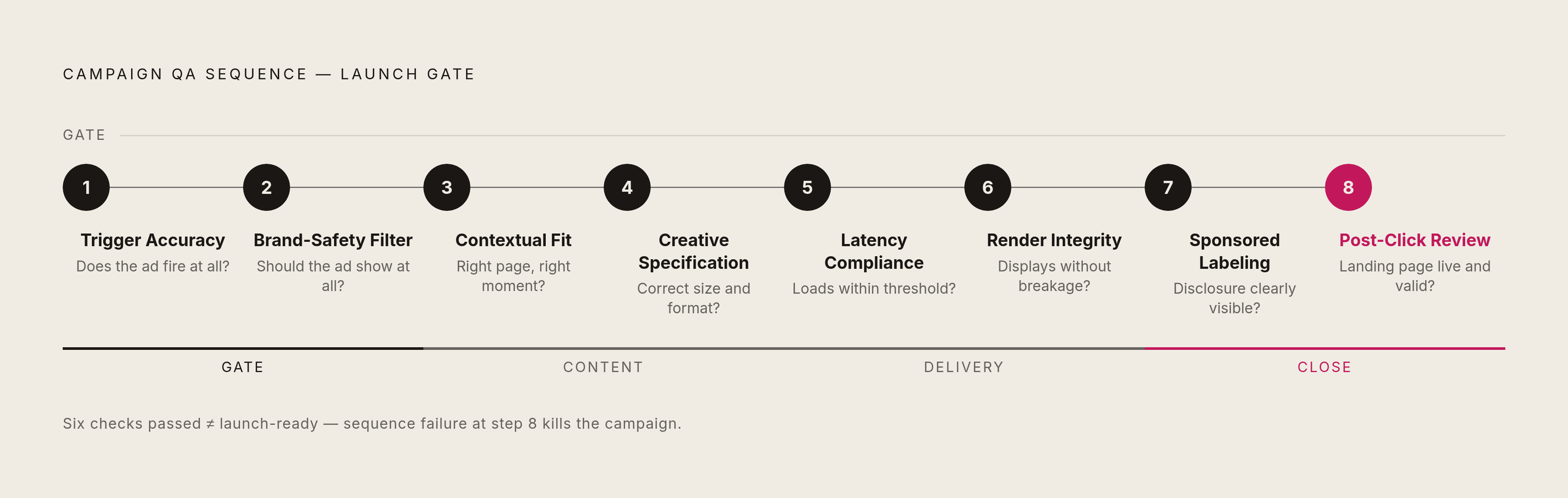
None of these checks work well in isolation. Trigger accuracy, contextual fit, latency, render integrity, labeling, brand safety, creative specs, and the post-click experience each catch a different kind of failure, and a campaign can pass six of the eight and still embarrass a brand on launch day.
The order matters more than it might seem. Trigger and brand-safety testing come first, since they decide whether an ad shows up at all and where. Contextual fit and creative specification come next, because they assume the trigger is already sound and now ask whether the specific match makes sense. Latency and render checks follow, since they test the technical delivery of an ad that's already been confirmed as the right one to show. Labeling audits and the post-click review close out the sequence, the last checks before budget actually moves.
Run in that order, on a written prompt test suite, against the live targeting configuration, before a single dollar is committed. Skipping a layer means the failure doesn't stay contained to that layer. It appears downstream, usually in front of a user, usually at the worst possible moment in the conversation.