Wiring Live Prompt Intent Into Your Campaign Targeting Workflow
Real-time conversational signals reveal intent earlier than keywords can capture.

Someone typing a request to plan a multi-step trip into a chat window is not searching. A system built to read live prompts reads it as the opening line of a problem the person is still working out, one that will unfold over several more exchanges before it resembles anything a campaign manager could have bid on in advance.
Why prompt-level intent signals differ structurally from keywords and behavioral data
That example matters because it shows what a keyword never holds. Meaning builds up across a conversation instead of sitting fully formed in any single line of it.
Consider a user who never types the name of a product category but spends several exchanges describing a scheduling conflict, a deadline pressing in, and a team that keeps dropping the same task. The privacy profile differs too: because relevance comes from what's being discussed in the moment rather than from a stitched-together browsing history, conversational context doesn't depend on tracking what a user did across other sites last week. It depends on what's in front of the model right now.
The forward orientation is the part legacy behavioral targeting cannot replicate. A keyword is a label; a conversational prompt is a narrative. Because conversational intent encodes the whole problem a user is trying to solve rather than a search term, systems built to read live prompt context, instead of historical behavior or keyword strings, can match relevance at the point intent is still taking shape, while the user's needs are still forming. That earlier point of contact is the structural reason this signal category deserves its own workflow rather than a keyword workflow with a new data source bolted on.
What the current ad infrastructure of conversational platforms provides, and what it does not
The four platforms running conversational AI at scale have landed on four different answers to how advertising works on their surface, and those answers reflect deliberate platform design choices. They set hard limits on what a targeting workflow can do on each surface.
Google's approach folds AI Overviews and AI Mode into the campaign infrastructure advertisers already run. Search campaigns using broad match or AI Max, Performance Max, and Shopping campaigns are all eligible to appear inside AI-generated answers. There is no opt-in and no opt-out: if a campaign qualifies under the existing rules, it is already serving inside AI answers right now. One constraint runs through all of it: there's no segmented reporting available for AI Overviews or AI Mode placements specifically, so an advertiser can see that a campaign is eligible but cannot isolate how it performs inside the AI surface versus anywhere else it's showing. That reporting gap limits attribution work before a campaign manager ever gets to the attribution stage.
Microsoft Copilot runs on a similar logic. Related to that, but a separate feature, is what Microsoft calls "ad voice," the in-block explanation Copilot gives for why a particular ad was included in response.
Perplexity took a different path and then reversed it. The company launched sponsored answers in November 2024, stopped accepting new advertisers in October 2025, and wound the program down by early 2026. Leadership told the Financial Times that sponsored placement risked making users start doubting everything the platform told them. That outcome is a data point about how fragile trust is in a surface where the product's entire value proposition rests on the user believing the answer wasn't shaped by who paid for it.
The split across these platforms is not a phase that will resolve into a single standard. It reflects a question nobody in the industry has answered yet: whether a conversational AI surface can carry advertising at all without damaging the thing that makes people use it. The Perplexity exit shows advertisers building a workflow around prompt intent must carry the brand safety question into that workflow from the start. The fragmentation across Google, Microsoft, Perplexity, and whatever surfaces come next, each with a different ad format, a different targeting mechanism, and a different reporting ceiling, is exactly the kind of problem that pushes advertisers toward a platform layer sitting above any single surface. A platform layer built specifically for conversational AI advertising can take in signal from multiple surfaces and apply one consistent bid logic across them, rather than forcing a team to relearn the rules separately for every platform it touches.
Signal ingestion: how conversational intent data enters a campaign workflow
Before any of this signal can be classified, scored, or bid against, it has to get from the surface where the conversation happened into whatever system is running the campaign. That step sounds mechanical. It is where most of the workflow actually breaks.
On Google and Copilot, the campaign is already serving and the platform is the one holding the contextual signal. The advertiser never sees the prompt directly. There's no raw conversational feed to ingest on these surfaces because the platform has already done the ingestion internally and handed the advertiser a narrower interface to it.
On a purpose-built surface like ChatGPT, the situation inverts. The context hint the advertiser writes functions as both the targeting input and the interpretation of that signal. Nothing about signal quality starts anywhere except with how carefully that hint gets written, which is a different kind of ingestion problem than pulling data out of a platform's reporting dashboard.
A third source sits mostly unaddressed inside most organizations right now: a standard website chatbot, or any conversational discovery tool a brand runs on its own site, produces its own prompt data. Getting conversational signals from a platform into the campaign stack requires data pipelines built for real-time prompt analysis, distinct from the keyword extraction or audience segmentation pipelines most martech stacks already have. In most organizations today, this first-party conversational data sits completely outside the campaign measurement tools and creative systems the team already uses, even though it was generated for free and reflects exactly the kind of intent language a campaign would want to target. That's a first-party data gap sitting unused in plain sight.
The first technical bottleneck in making any of this work is building the pipeline that captures the signal and times its arrival so the rest of the workflow can act on it before the conversational moment passes.
Intent classification: reading the conversational trajectory, not just the current query
Once signal is flowing, the next job is figuring out what it means, and that requires reading the trajectory of a conversation rather than scoring whatever the user typed most recently. This is the step where legacy ad infrastructure is least equipped to keep up, because it was built to score discrete queries, not evolving dialogue.
The transformer architecture underlying these conversational systems maintains discourse coherence across multiple turns by design. An intent classification system has to do the same work: scoring that single question in isolation, without the conversational history behind it, would miss what's actually being asked.
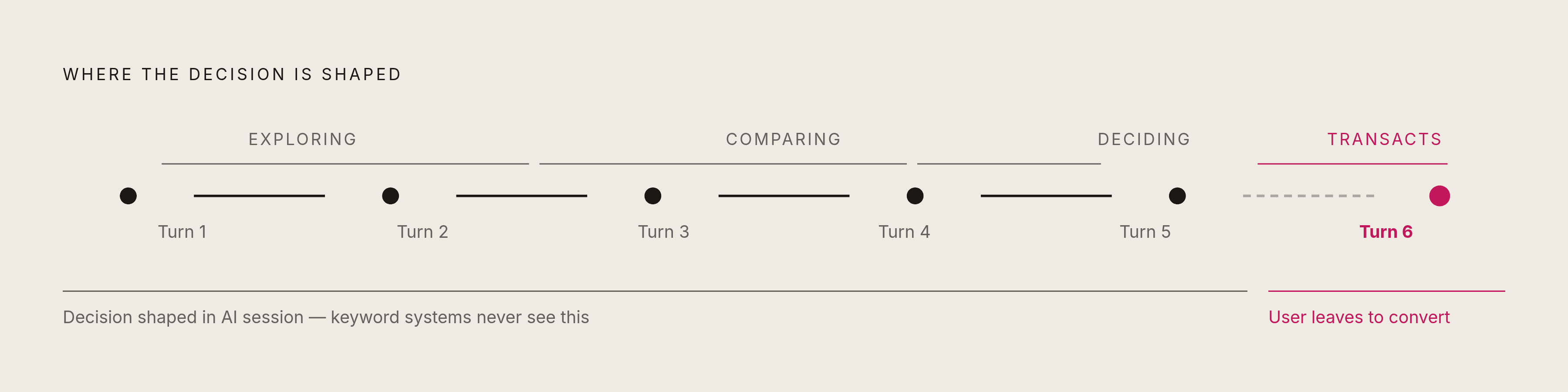
Conversational intent isn't concentrated at the bottom of the funnel either. Each of those phases calls for a different kind of ad response, and that mapping falls directly out of reading the trajectory rather than scoring a single line.
There's a concrete number that makes this urgent rather than theoretical: users typically go about six prompts deep before they leave the AI conversation and move to the open internet to convert. A classification system that only triggers on the final transactional message in that sequence misses most of the conversational journey, which is exactly where influence over the eventual decision got built. Reading trajectory also catches something keyword systems were never built to catch at all: the vocabulary people use before they've settled on a product, or even a category, reveals a segment forming in real time. A brand that can read those early-stage word choices gets a chance to reach a market before competitors have noticed the category exists.
The obvious objection is that real-time multi-turn classification is computationally demanding, and that most ad infrastructure was never built to hold conversational state across exchanges the way this requires. That objection undersells what's already available, though. The LLM surfaces themselves already maintain conversational state in order to generate a coherent reply in the first place, and advertising systems built on top of them can draw on those same contextual representations rather than building the capability from nothing. The classification system is borrowing state the model already computed, not re-deriving it independently.
Context hints as the advertiser's primary targeting instrument
Writing a context hint is a genuinely new skill, closer to copywriting than to keyword research, and the gap between teams that treat it that way and teams that don't appears directly in how well their ads get matched.
A keyword asks what string someone typed. A context hint asks what the person is trying to accomplish and whether the advertiser's offer is actually useful to them at that moment in the conversation. That means a hint has to encode a problem narrative and a relevance claim rather than a list of topics the advertiser thinks it belongs under. Teams that write hints as comma-separated topic lists get poor matching, consistently, because a hint like that describes a category instead of describing the conversational situation the advertiser actually wants to be relevant inside.
The coherence requirement is where most of the chain quietly breaks. The auction reads the context hint alongside the ad title, the ad copy, and the landing page, all four at once, as a single relevance signal. All four pieces have to tell the same story about what the advertiser offers and to whom, or the system reading them treats the mismatch as a relevance problem rather than forgiving it as a formatting issue.
Because the auction is relevance-weighted and runs on a second-price basis, a precisely written hint backed by a smaller budget can outcompete a vague hint backed by a much larger one. Before any hint gets written, the preparation work is intent mapping: cataloguing the real questions buyers are asking AI tools across discovery, evaluation, and decision stages. That mapping work surfaces conversational situations worth targeting that keyword research was never built to find, because the vocabulary people use in conversation with an AI model differs from the vocabulary they type into a search box.
Bid logic in a relevance-weighted auction with no keyword layer
Bidding inside a conversational AI auction runs on different logic than keyword bidding, because the auction weighs relevance against price together rather than treating bid amount as the deciding factor. Targeting precision and bid strategy stop being separate decisions and start determining each other.
In a relevance-weighted, second-price auction, a more relevant ad can beat a higher bid. That inverts the usual relationship between budget size and competitive position: a smaller advertiser with a precisely targeted hint can outplace a larger advertiser running a vague one. Google's AI surfaces require smart bidding rather than manual bidding: AI Max's key features, including search term matching, depend on automated, conversion-based smart bidding running underneath them. That requirement raises the data bar for the whole channel: the campaign has to feed the automated bidding system enough conversion signal to optimize against before it can perform.
ChatGPT structures the choice differently, offering three distinct objectives: a Reach objective bought on a CPM basis, a Clicks objective bought on a CPC basis, and a Conversions objective, billed per click under an oCPC model, that optimizes toward a tracked conversion event rather than toward raw clicks. The bid has to reflect the value of the conversational moment as a whole.
None of these are standardized yet, but any bid logic framework built today needs room to price against them as they become tradeable, because each one prices the outcome of a conversation rather than a single moment inside it.
Creative matching: aligning ad format and message to conversational phase
Creative has to match the phase of a conversation, because the same offer needs a different message depending on whether the user is exploring broadly, comparing a short list of options, or asking directly for a recommendation.
When a conversation is still broad and exploratory, the right message is an awareness message. As the person clarifies what they need and the follow-up questions narrow toward specific requirements, the creative should narrow with them, reflecting what the conversation has already established rather than starting the pitch over from zero.
The placement geometry on ChatGPT makes this discipline non-negotiable. The ad unit sits below the answer as a labeled sponsored card, never woven into the answer text itself. Because of that separation, the creative has to stand on its own and be immediately relevant without leaning on the model's own response to supply missing context. A hint that correctly identified a decision-stage comparison question, paired with creative still written for a broad awareness audience, wastes the precision that went into targeting the conversation. The creative is the layer where most of that upstream work either pays off or gets thrown away, and most advertising teams currently underinvest in it relative to how much it shapes whether everything built before it lands.