Attribution Models for Assistant-Mediated Conversions
Web attribution models can't measure influence that unfolds inside a chat conversation.
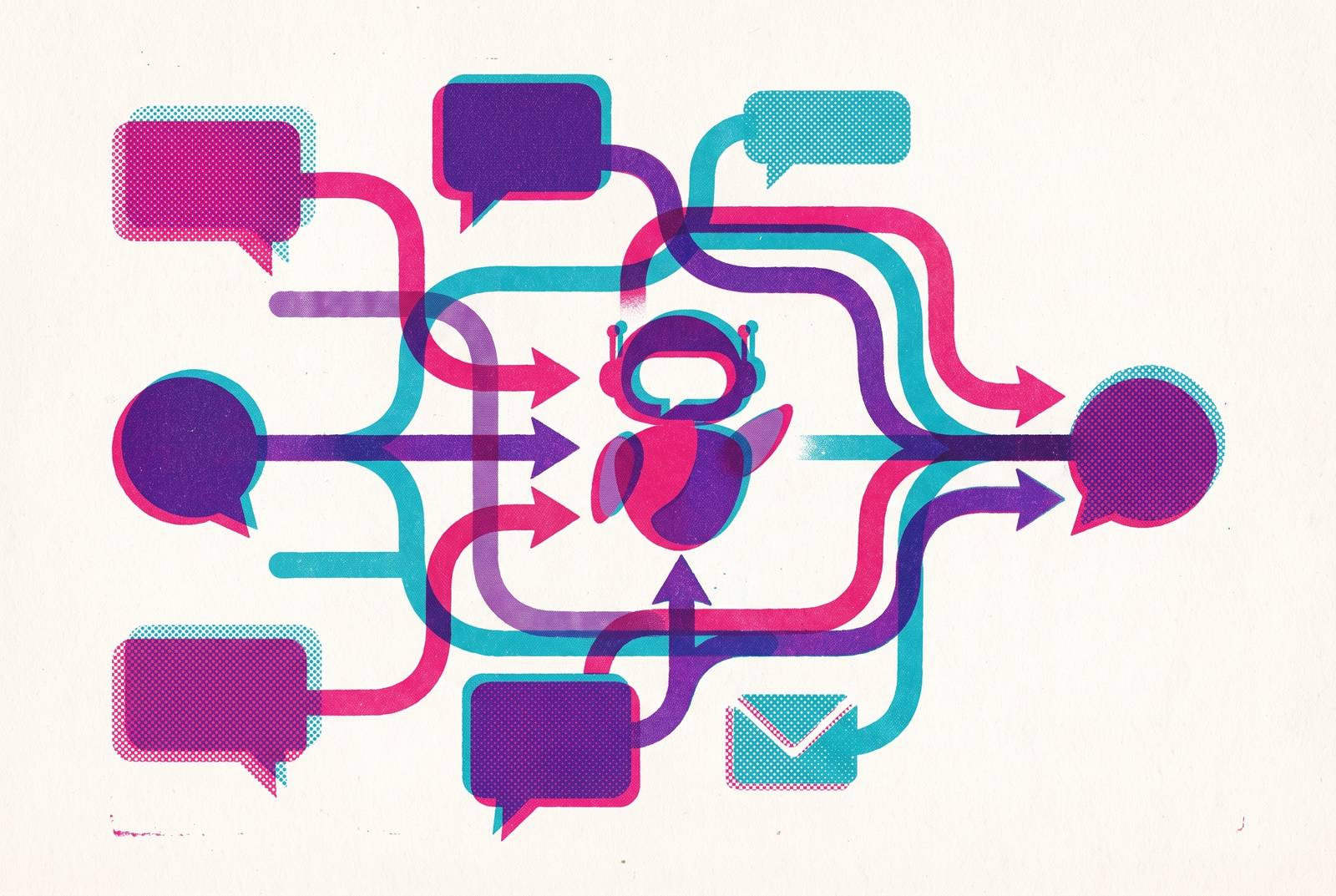
Attribution models built for the web assume a journey made of discrete, loggable steps: impression, click, landing page, conversion. Conversational AI collapses that journey into something no pixel was built to see, and the gap between what these platforms measure and what actually happens inside a chat session is the subject of this piece.
Why page-bound attribution models fail inside a chat session
Say you research project management software on a Monday. You come back Wednesday to compare pricing, then convert on Friday through a different channel. A standard attribution system logs this as three unrelated events, scattered across days and perhaps across devices. What actually happened is a single, continuous consideration journey that played out inside one chat session, a session the attribution system has no way to recognize as one thing.
The destination after an ad exposure, in this setting, is continued conversation inside the AI interface itself, in a space where no pixel, cookie, or session tracker can follow. Multi-turn exchanges build context as they go: the brand mention that actually shapes the decision might appear in message three of a fifteen-message exchange, with the real conversion decision taking shape gradually across the turns that follow. Attribution infrastructure built for the web cannot distinguish any of this. It sees a session or it doesn't. It cannot see a conversation unfolding inside one.
The asynchronous nature of these platforms makes the problem worse. A saved ChatGPT conversation stays accessible indefinitely, but it won't if you turn on Temporary Chat mode or disable chat history. That means the span between a first ad exposure and a final conversion can stretch across days and across devices, with no session timeout to mark where one interaction ends and another begins. Page-bound attribution depends on exactly that kind of boundary. Conversational AI has nothing like that, so the old models, built around the click, the cookie, and the thirty-day lookback window, end up measuring a shape that isn't there anymore.
Where last-click, first-touch, and data-driven models each break down
Each of the three dominant attribution models fails at a different point of contact with conversational AI, and knowing where each one breaks tells practitioners precisely what can be salvaged and what can't.
Last-click attribution credits the final touchpoint before a conversion, on the assumption that influence builds in a straight line and that the decisive moment sits closest to the transaction. Inside a multi-turn chat session, the final action before conversion might be a direct site visit or a quick search, but both were triggered by a brand recommendation that surfaced many turns earlier. That final click gets the credit, but it's just an arbitrary endpoint, and last-click attribution never looks upstream to where the cause actually happened.
First-touch attribution credits the moment of awareness, assuming there's a clean, trackable instant of first exposure to point to. When that first brand mention arrives as a native recommendation woven into an AI response, no tracked impression exists for the model to credit. The moment of awareness happened, but it happened somewhere the measurement stack has no visibility into.
Data-driven, or algorithmic, attribution distributes fractional credit across every observed touchpoint in a conversion path, which sounds like it should handle complexity better than the other two. It still assumes that all the touchpoints involved get observed. If in-conversation influence never produces a click, this kind of model simply can't see it. The algorithm ends up optimizing against an incomplete picture of the journey, and it systematically undervalues the conversational channel because so much of what it does leaves no trace the model can read.
All three models share one design choice that produces their differences: each treats the click as the basic unit of observed influence. A research framework for LLM advertising lays out the core modules any such system needs, modification, bidding, prediction, and auction, and argues that each one requires rethinking because the click simply isn't the primary influence event inside a conversational interface. Adjusting a lookback window or tracking another parameter doesn't fix that. The flaw sits in what the models were built to count.
What conversational intent signals contain
What these models miss isn't a technical footnote. You get a far richer signal than anything legacy measurement was ever asked to capture. A prompt inside a conversational exchange often contains a budget, a set of constraints, a shortlist of alternatives, and a record of what the user already rejected. A three-word search query carries none of that.
Consider a user asking a simple question like "What's the best fitness app for beginners?" That single turn already says more about intent than a search query would. A multi-turn exchange goes further, layering in follow-up constraints and refinements in real time, producing a signal that no keyword list or demographic profile can approximate. The user isn't just expressing interest. The user is narrating a decision as it forms.
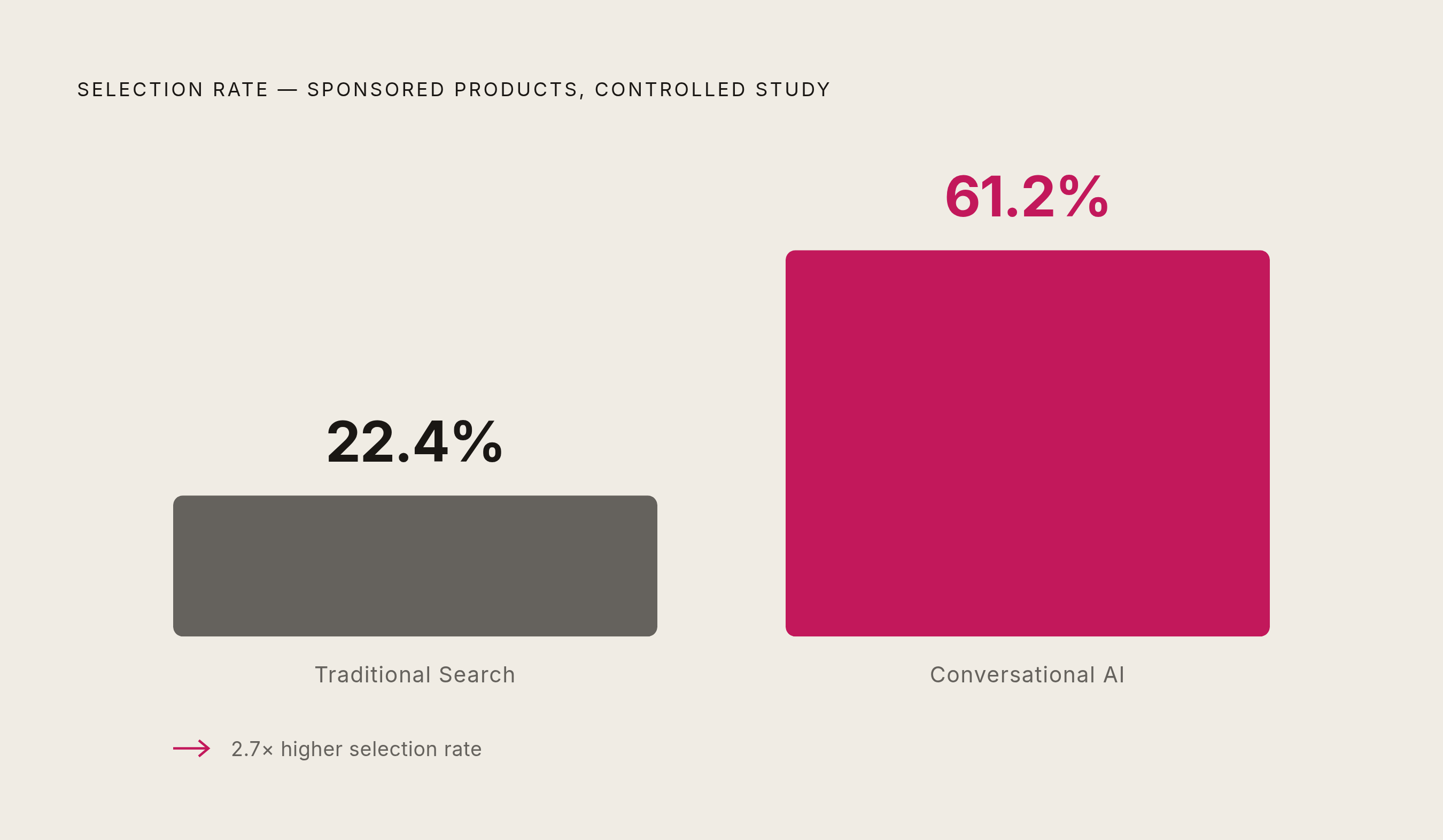
Research on commercial persuasion in AI-mediated conversations found that LLM-driven product promotion reached a 61.2% selection rate in a controlled study, compared with 22.4% for traditional search placement, nearly tripling the rate at which people chose sponsored products. That gap shows how deep the influence of conversational interfaces runs; it isn't just a difference in visibility or placement. A channel capable of moving purchase decisions at that scale deserves measurement built to match it, rather than a legacy proxy that treats most of what happens inside the conversation as unobserved.
Mapping new conversational performance events to attribution systems
The monetizable moment in conversational advertising is shifting: it's moving away from the page impression and toward the intent expressed inside a conversation. That shift is already producing new kinds of performance events, and most existing attribution pipelines can't take them in without real changes on the advertiser's side.
New measurement primitives are starting to appear: assisted conversations, purchases tied to a suggested action, contribution credit spread across multi-step chat histories. These exist because the channel measures influence that unfolds across dialogue, not influence that resolves in a single click. Some platforms already offer one-day view-through conversion reporting, and it records a conversion if it happens after an impression, even without a qualifying click. That's a real step toward capturing in-conversation influence. It requires no changes to an advertiser's existing pixel or Conversions API setup: the same submitted conversion events support both click-through and view-through reporting automatically.
The academic framework for LLM advertising points to the prediction and auction modules as the components most in need of redesign. The prediction module needs to estimate conversion likelihood from conversational signals rather than from historical click-path data, because click-path data now describes only a minority of what drives the outcome. These new events are real and platforms are starting to expose them. They are not yet ingestible by legacy attribution stacks without architectural work on the advertiser's end, and that work is the subject of the next section.
What first-party data architecture must carry
Solving attribution for assistant-mediated conversions takes changes that sit upstream of the attribution model itself. The data captured at the moment of click-through has to carry enough conversational context to let someone reconstruct the journey later, because the attribution system will never get access to what happened inside the AI session directly.
So every URL generated for traffic coming from a conversational AI surface needs to encode more than source and medium. It needs to carry conversational context too: a query intent category, a measure of conversation depth, some marker of competitive context, so that the analytics and CRM systems downstream actually have something to work with. Without that context attached at the point of click-through, the information is gone for good; there's no second chance to recover it later from inside the AI platform.
The Conversions API passes events server-side rather than through a browser pixel, so it's the necessary complement to those URL parameters. It closes the loop between a conversion event that happens off-platform and the platform's own attribution system, and it matters most for view-through conversions, which by definition never produce a trackable click for a pixel to catch. Legacy data collection doesn't wait as a neutral input for a smarter model to interpret it correctly. Built the old way, it introduces its own systematic error before any model gets involved, so it drops exactly the context a better framework would need.
Session-level and conversation-depth signals as the natural unit for a purpose-built attribution framework
A framework built specifically for assistant-mediated conversions should treat the conversation session itself, not the click and not the impression, as its basic unit of measurement. Influence accumulates across the session, and the session is the one bounded event that can actually be reasoned about from the outside.
Inside that frame, conversation depth becomes a real signal, and you can track it in its own right. A user who engages with a brand mention in turn three and then asks four follow-up questions about it is expressing a fundamentally different kind of intent than a user who scrolls past a sponsored card without a second look. A framework built for this channel has to be able to tell these two users apart, something neither a click count nor an impression count can do on its own.
If the conversation itself is the unit of measurement, a user who resumes an existing thread days later counts as a continuation of a known attribution event rather than a brand-new, disconnected session, which resolves the asynchronous-return span described earlier. That only works if the platform exposes session identifiers that the advertiser can actually match against its own CRM records, which loops back to the infrastructure work described in the previous section.
You can see this logic most clearly on the supply side, in Microsoft Copilot. Its ad-triggering model looks at the whole conversation within a single session, not just the most recent query, to decide which advertisers are relevant, and a separate "ad voice" feature explains how a given sponsored section connects back to the conversation that produced it. That design implies attribution should weight the arc of a conversation rather than its terminal click, and it shows that at least one major platform already treats the session, not the query, as the meaningful unit of analysis.
What remains genuinely unsolved in measuring assistant-mediated conversions
Even a carefully built session-level framework can't fully solve attribution for assistant-mediated conversions today. The most important influence events, the specific turns inside a conversation where a brand recommendation actually takes hold, happen inside a closed system the advertiser has no way to instrument directly.
The view-through window, the Conversions API, and conversation-depth proxies like engagement rate or follow-up click latency are real signals, and you can use them. They remain partial substitutes for the in-session data the platform holds and the advertiser simply doesn't have. The persuasion research cited earlier carries a further complication: when the LLM in that study was instructed to conceal its promotional intent, detection accuracy by participants fell to just 9.5%. That finding points to a genuine measurement irony. Conversational influence works best when you notice it least, so the highest-performing conversational campaigns may show up as the weakest ones in a legacy dashboard, simply because their effects leave the least trace for old tools to find.
None of this is a reason to wait. So for now, you should treat conversational AI as an assisted channel inside existing attribution models, instead of forcing it to compete for last-click or first-touch credit it will structurally never win. So invest in Conversions API integration ahead of pixel-only measurement, build CRM fields for conversational context parameters before spend scales up, and hold session-level engagement metrics alongside downstream conversion data. The category hasn't settled on its measurement norms yet. Platforms are still introducing new conversion event types, and bidding constructs like CPEC and CVO, which make session-level influence legible to buyers, are themselves new. Any framework built now should be built to absorb new signal types as platforms expose them, not locked permanently to whatever data happened to be available at launch. Practitioners who understand precisely why last-click, first-touch, and data-driven models fail here are the ones positioned to build toward something durable, one infrastructure decision at a time, rather than waiting on a perfect solution that doesn't exist yet.