Multi-Turn Conversation Ad Sequencing
Ads now need to evolve across an AI chat's turns, not bid on each prompt in isolation.
Multi-turn conversation ad sequencing means matching different creative and offers to different stages of a single AI chat, instead of treating each prompt as its own isolated ad opportunity. Traditional ad matching was built for one query, one intent signal, one response. Conversational AI doesn't behave that way, and most platforms are still bidding on individual turns as if it did, which is the wrong unit of analysis entirely.
A user opens with "what should I cook this week," and three turns later lands on "where can I buy a cast iron pan under $80." That's not one intent. It's three or four, stacked and evolving. An ad served at turn one is guessing at a purchase that hasn't formed yet. The same ad served at turn four is already behind the user, who has moved past category browsing into a specific, priced, purchase-ready question. Existing ad delivery logic, built for discrete, stateless search queries, has no native concept of where a user sits inside that arc. This piece lays out what ad delivery needs to look like when the unit of context is a conversation, not a query.
What turn-by-turn intent progression actually looks like
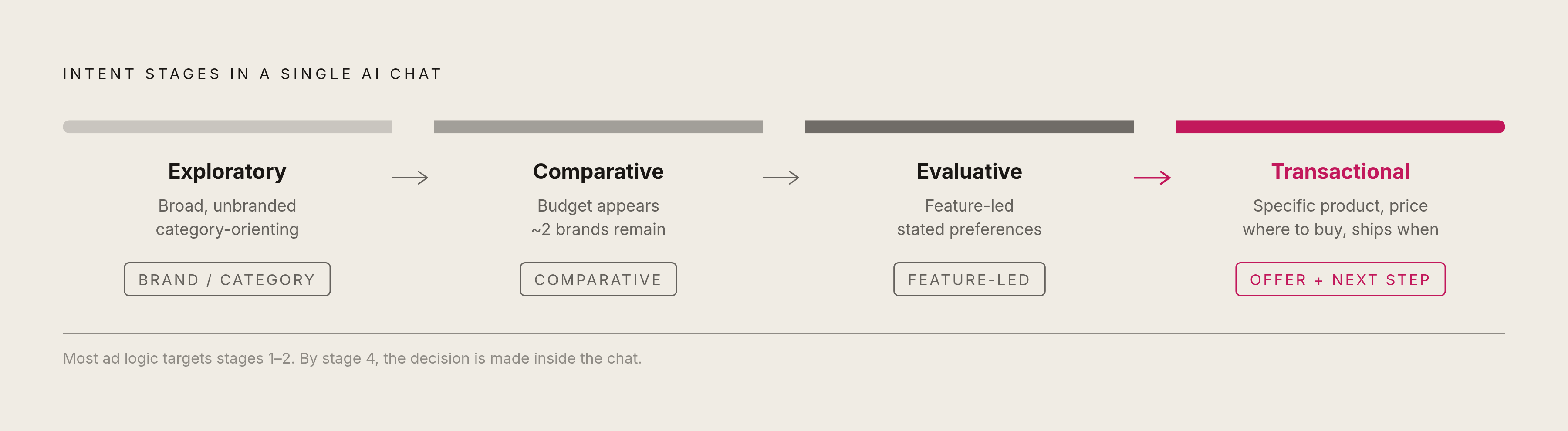
Intent in a multi-turn chat moves along a recognizable path: exploratory, then comparative, then evaluative, then transactional. Early turns are broad and unbranded. The user is orienting to a category, not choosing between options yet. A growing share of pre-purchase digital journeys now start in an AI chat, and those opening prompts are typically unbranded, because the consumer hasn't decided what they want yet either.
Middle turns are where the user starts narrowing. Budget shows up. Use case shows up. A stated preference shows up, and the consideration set shrinks fast, a user starting an auto purchase journey in chat tends to land on roughly two brands, not the ten-link results page a traditional search would hand back.
By the late turns, intent is transactional: specific product, specific price, where to buy it, when it ships. Treating an early turn and a late turn as the same ad opportunity wastes both. Travel makes the early stage worth taking seriously on its own terms: over 37% of travel queries start in an LLM, and those first prompts often carry destination preferences, travel dates, and group size, the kind of detail a keyword search never surfaces. The system needs to know what stage of the arc a user occupies. Knowing what words showed up in the last message isn't enough.
How ad delivery systems track conversational state
Tracking conversational state is the real engineering problem underneath all of this. The system has to hold a running model of the dialogue, not just parse the most recent line.
OpenAI describes ChatGPT's ad targeting as contextual matching based on the current conversation's topic and, where a user has ad personalization turned on, past chat history. That's a different mechanism than keyword targeting: the matching signal builds as the conversation goes, with each turn updating what the system believes the user is after. Advertisers submit "context hints," short free-text descriptions of the conversations where their product fits, and the platform scores ads against that profile at the moment one actually gets served.
The auction, weighted by relevance, is scoring contextual fit rather than word overlap, and that fit sharpens as the conversation matures. Microsoft's Copilot pushes this further with dynamic filters: instead of typing another question, the user clicks a filter to refine results, which makes the click itself another turn in the conversation. The ad pipeline has to treat conversation history as a structured object, not a single query string. Worth separating this from retargeting, too: the mechanism described is reading the live arc of one conversation, in real time, as it happens.
The three placement moments that correspond to intent stages
ChatGPT's three ad placements, which entered open beta in May 2026, line up fairly neatly with those intent stages. ChatGPT's in-chat sponsored placements fit best at mid-to-late intent, once a question already has a clear commercial answer attached. Suggested follow-up placements appear after a response and push the conversation forward rather than waiting for the user to get there on their own. Shopping-oriented placements serve as the transactional format, built for the moment product and price are all the user cares about.
Microsoft's Copilot answers with Showroom ads, launched in April 2025 with a global rollout planned, which bring in rich sponsored content, images, product details, triggered by buying intent rather than by turn number. Copilot's planned brand agents go a step further, letting a user talk directly to a virtual brand representative through the ad itself, which turns the ad into its own nested multi-turn exchange inside the larger conversation.
Target's pilot with OpenAI, which began in February 2026, shows a late-funnel placement doing its job. Sponsored, clearly labeled ads from Target and its Roundel partners show up alongside shopping conversations in ChatGPT, triggered by keywords in the user's prompt. In one example, a user asks, "What are some countertop cooking appliances that make everyday meals more convenient?" and the system serves an air fryer ad from a pilot participant, shown separately from ChatGPT's actual answer, with no influence on what that answer says. One rule holds across every platform doing this: ads stay visually separated from the organic response and carry a clear "Sponsored" label. Placement logic that ignores that separation doesn't get to run at all, full stop.
Sequencing creative across turns, not just serving the best ad at each one
Matching an ad to the current turn answers one question: what fits right now? It doesn't answer the harder one: what should the user see next, given everything they've already seen? That second question is what sequencing means, and answering it takes a deliberate creative strategy built around the intent arc. A smarter matching algorithm alone won't get you there.
Audio advertising offers a useful parallel, and it's worth taking seriously rather than treating as a nice analogy. Research on audio ad sequencing found that campaigns opening with a brand-building message and following it with a promotional or call-to-action spot produced double-digit lifts in recall, search intent, and purchase behavior, purely from getting the order right. Order drove the outcome, not frequency.
Applied to a multi-turn AI chat, early turns should carry brand or category creative that builds trust before anyone's ready to buy. Mid turns call for comparative, feature-led creative that helps narrow real options. Late turns want offer-led creative with an obvious next step. ChatGPT's follow-up placements are among the clearest tools available for doing this on purpose: a brand can use them to push a user toward the next stage instead of waiting for that shift to happen on its own.
Traditional creative rotation, swapping in new creative once click-through flattens and cost-per-acquisition climbs, doesn't translate here. Fatigue within a single conversation matters less than serving creative that's simply wrong for the stage the user is in. Before launch, the buyer has to map, stage by stage, exactly what creative belongs where, and what signal in the conversation should trigger the handoff from one stage to the next. Buyers who skip this step aren't sequencing. They're just rotating ads and calling it strategy.
What signals tell the system to advance, hold, or exit the sequence
Some signals clearly mean the conversation moved forward. A user introduces a constraint, a budget, a brand name, a location. A user asks a comparative question. A user names a specific product. Each marks real advancement in the intent arc.
Other signals mean nothing has changed. A clarifying question asked at the same level of specificity as before doesn't shift the intent stage, so the creative shouldn't shift either.
And some signals mean the sequence should stop outright. The user changes topic, or the conversation hits a transactional endpoint, clicking a shopping card, for instance. Continuing to push commercial messages into a conversation that's already resolved or moved elsewhere doesn't help anyone; it just annoys them. Conversation history needs to function as a cumulative record, tracking which stages a user already passed through, so the system doesn't loop back and repeat a brand-awareness pitch to someone already deep in late-funnel mode. Past ad interactions feed directly into this. Where a user has ad personalization enabled, ChatGPT's targeting can fold prior ad engagement into its contextual matching, so a user who clicked an earlier sponsored placement may be handing the system a forward signal worth acting on. Copilot's dynamic filter similarly captures engagement: a click instead of a typed question refines the conversation's direction and can inform how delivery evolves.
None of this happens automatically on the buyer's behalf, though. Intent-stage definitions have to be written into the campaign brief itself. The platform reads a conversation fine. It has no way to guess a brand's sequencing intent without being told what that intent is.
How current platform auction mechanics interact with sequencing logic
ChatGPT runs a relevance-weighted auction with a $60 CPM rate, accessible through the self-serve OpenAI Ads Manager with both CPC and CPM bidding and, as of May 2026, no minimum spend. The auction picks the best ad for an eligible conversation at the exact moment it's served, optimizing for relevance to that turn. It isn't optimizing for a buyer's sequencing plan across turns, and that's exactly where the friction shows up.
A buyer trying to hold a brand-awareness message in place for early-funnel turns can get outbid by a competitor running a more conversion-oriented ad that reads, correctly, as more contextually relevant to the algorithm. Sequencing is a bid strategy exercise as much as a creative one. Buyers likely need different CPM or CPC bids attached to different intent-stage targeting categories just to hold position at each stage, rather than getting priced out of the early stages entirely.
Topic-category targeting, a broad category paired with subtopic refinement, is the closest thing to intent-stage targeting that current platforms offer, and it's a blunt tool next to real turn-level sequencing. It's also probably a temporary one. The Token Auction model, presented at WWW 2024, and a more recent LLM-Auction proposal from a December 2025 arXiv preprint both explore systems where advertisers bid to influence the actual words an LLM generates, or where ad placement gets treated as a preference-alignment problem rather than a slot auction. Both point toward a future where sequencing logic lives inside the bid mechanism itself. For now, buyers on live platforms are stuck approximating with intent-category targeting and creative built by hand for each stage. The sequencing happens at the planning layer. The auction hasn't caught up yet.
What the early performance data implies about sequenced versus unsequenced delivery
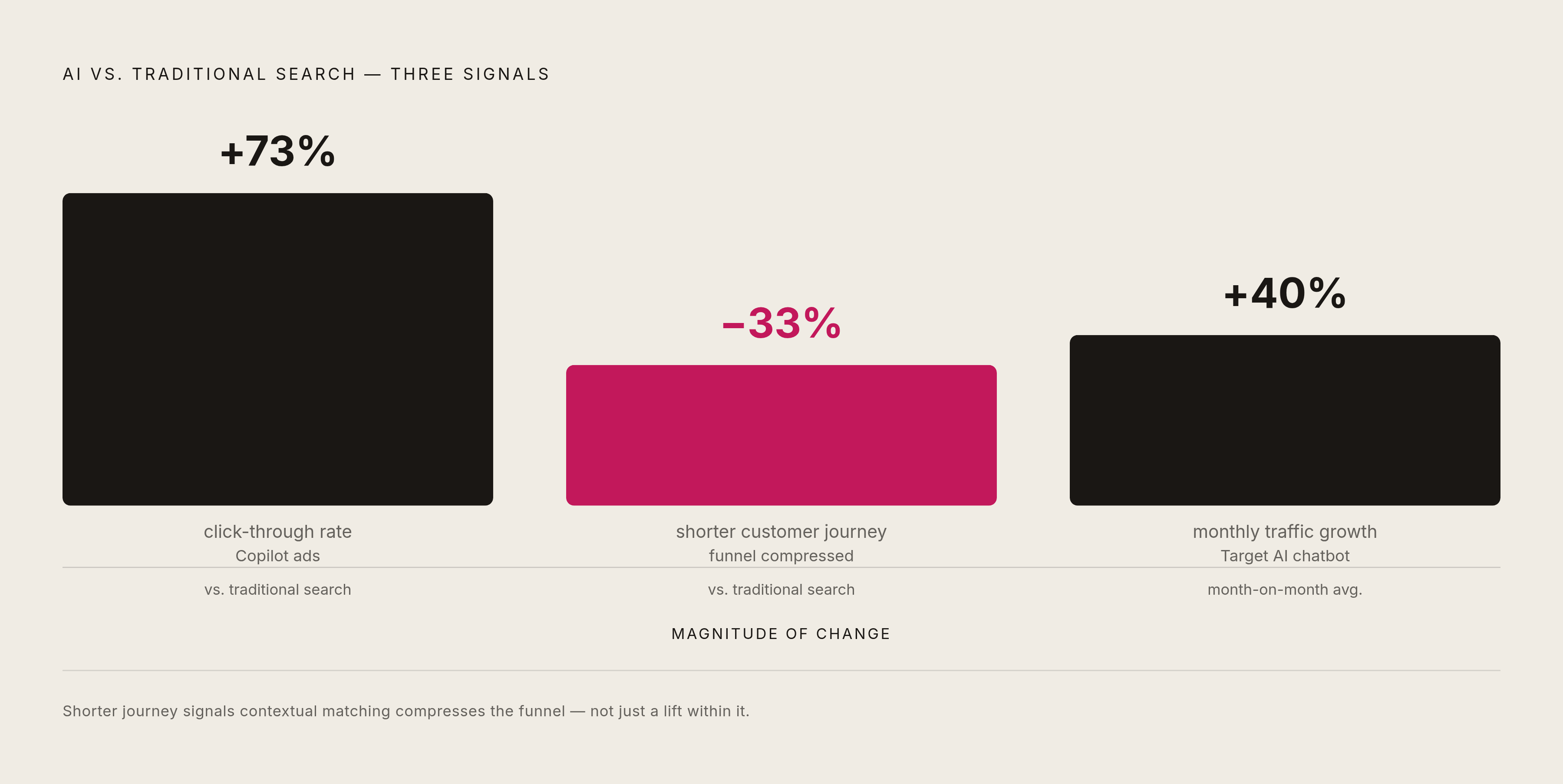
Microsoft's first-party data shows Copilot ads producing 73% higher click-through rates than traditional search and customer journeys that run 33% shorter. That last figure is the one worth sitting with: a shorter journey suggests contextually matched ads compress the funnel, rather than just performing better within the same funnel length.
Target reports traffic from its AI chatbot pilot growing 40% on average every month since launch, a directional sign that showing up at the right moment inside a conversation moves people past the chat window itself. What none of this data does, though, is isolate sequenced delivery from plain single-turn contextual matching. No published numbers separate a deliberately sequenced campaign from one that's simply well-targeted at each turn in isolation. That gap says something on its own: the industry is building sequencing practice ahead of having benchmarks to measure it, leaning on intent logic and adjacent evidence, like the audio research above, because AI-specific sequencing data doesn't exist yet.
What brands and buyers need to build before sequencing is executable
Before a line of creative gets written, the intent arc needs mapping. What stages does a target user typically move through, exploratory, comparative, evaluative, transactional, and what specific language marks the shift from one to the next? Skip this step and you're guessing at sequencing, not executing it.
From there, every stage needs its own creative, built as a distinct library rather than one hero ad stretched across the whole conversation. A brand-awareness message that lands fine at turn one reads as noise, or worse, at turn five. Topic-category targeting should get structured by stage too: early-funnel categories carry the brand creative, late-funnel categories carry the offer creative, using whatever subtopic refinement the platform allows to approximate true stage targeting.
Bid strategy needs its own logic layered on top. If the auction rewards relevance, late-funnel placements close to conversion probably justify a higher bid, while early-funnel placements, where the goal is volume and exposure rather than an immediate click, don't. Exclusion logic matters just as much: a user who already clicked a shopping card, or who's clearly moved on, should drop out of the sequence rather than get served another commercial message into a resolved conversation.
Measurement is the piece still missing a clean answer. Platform metrics like click-through and conversion rate get reported in aggregate across turns right now, not broken out by turn, so buyers need to instrument their own downstream signals, time on site, pages per session, return visits, to work out where in the sequence conversion actually happens. Adobe Analytics offers a useful baseline: users arriving via AI referral spend 8% more time on site, view 12% more pages, and bounce 23% less than users from traditional sources. That's not proof sequencing works. It's a floor for what good conversational traffic looks like, and it's the bar sequenced campaigns will eventually have to clear. The platforms that can offer both reach across surfaces and the ability to actually read conversational context, not one or the other, are where sequencing gets built consistently. Everything else is still working the problem one surface at a time.
Sources
- Conversational AI redefines audience engagement
- Captivating and relevant: How conversational AI is changing advertising
- Meta’s new conversational ad targeting, smarter creative rotation frameworks, and fresh insights on audio ad sequencing | Colling Media
- About Target's conversational AI advertising test
- LLM-OSDA: An Optimal-Stopping Dynamic Auction for Native Advertising in Multi-Turn LLM Conversations

