Bid Strategy Selection for Conversational AI Placements
Conversational AI auctions reward relevance over bid size, requiring new strategy.

Bid strategy selection for placements inside conversational AI systems can't borrow wholesale from search or social. What's being priced isn't a keyword match or a stored behavioral profile; it's the live meaning of a single turn inside a conversation, a structural difference. That difference changes what "relevance" means, how auctions clear, and which bid strategies actually make sense to run. This piece maps the mechanics and gives advertisers a way to match bid strategy to the intent signal actually present in the conversation, rather than the one their existing playbook assumes is there.
A search query is a string an advertiser bid on ahead of time, matched against something a user typed once. A prompt in a chat interface carries register, purpose, and the residue of everything said earlier in the session, and it usually sits at a specific stage of the user's decision process that a keyword string simply cannot encode. When someone asks "what should I use for X," that's a different moment than someone asking "where do I buy X tonight," even though both might trigger the same keyword in a search engine. The declarative, immediate nature of a prompt (the user is stating what they need right now, not matching against a term picked days earlier) is why platforms in this space describe targeting in terms of "context hints, not keywords." Advertisers describe the conversations and intents they want to show up in; they don't buy a term.
How the auction inside an LLM works, and what makes it relevance-weighted
Most conversational AI placements carry one ad. A single sponsored card sits beneath the assistant's answer, and there's no ten-blue-links page to fight over. That alone changes bidding logic: there's no "position three versus position seven" to buy your way into.
The auction underneath is a second-price mechanism, but relevance-weighted. The bid gets multiplied by how well the ad fits the conversation, so a tightly relevant ad at a lower bid can beat a generic ad at a higher one. That's the core mechanical break from search: in a search auction, a higher bid reliably buys a better slot. In a relevance-weighted auction, bid and relevance interact, so overpaying for a bad match is both expensive and pointless. You can't spend your way past a weak fit.
One published framework for this kind of system, LERA, describes a two-stage process. First, embedding-based filtering narrows the field to a set of candidate advertisers cheaply. Then the language model itself gets queried to produce logits over those candidates, generating a refined, organic relevance score for each one. Those scores combine with bids under a critical-value payment rule designed so that bidding what the ad is actually worth to you remains the advertiser's best strategy. The mechanism is built to punish bid inflation on weak matches rather than reward it.
The three intent states a conversation can be in
Conversational interfaces flatten the funnel. A single chat window handles the person still researching and the person ready to buy tonight, and both look, structurally, like "a user typing a message." Bid strategy has to do the work of telling them apart.
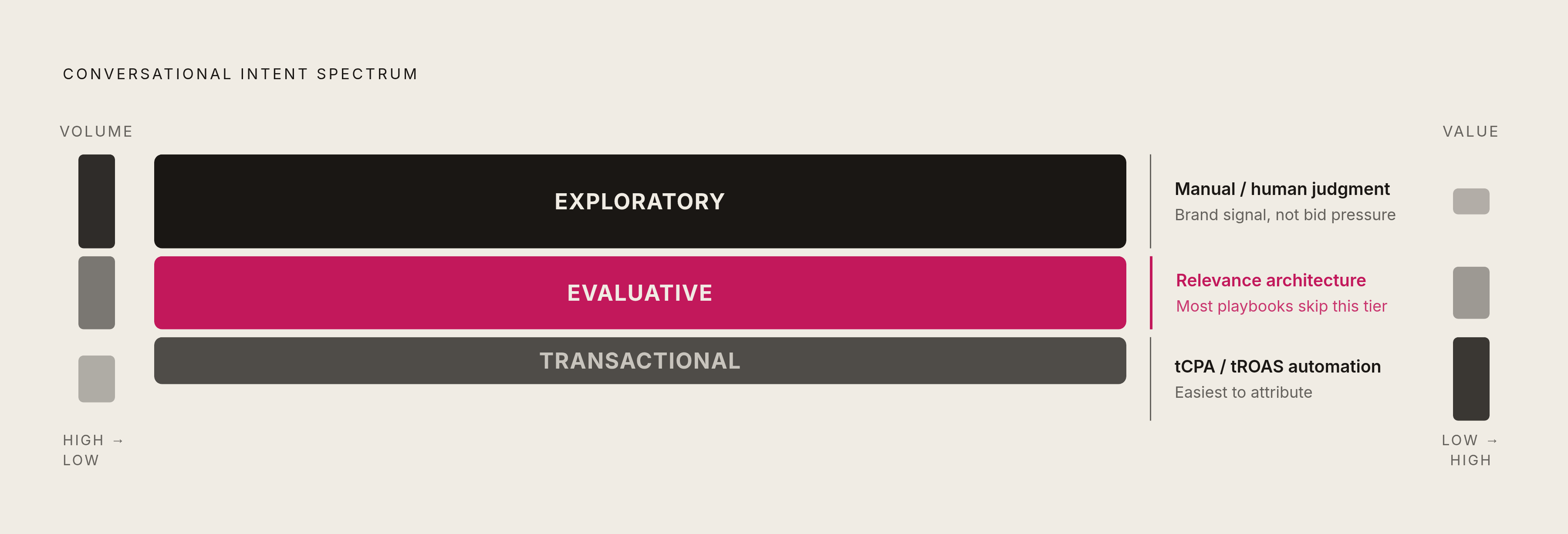
Three intent states recur in how this inventory behaves. Exploratory or informational intent covers the user gathering information, comparing, learning; the intent is genuine but a purchase isn't imminent. This is the highest-volume state and the lowest commercial temperature. Evaluative or comparative intent is the user who already has a category in mind and is narrowing options, actively responsive to a recommendation; this is moderate in volume but high in relevance opportunity, and it's the point where a brand mention can actually swing a decision. Transactional or action-ready intent is the user asking for a source, a deal, a next step; lowest volume, highest commercial value, and the easiest to attribute directly.
The conversation itself acts as the classifier. Prior turns, the specificity of the current prompt, and even the vocabulary chosen all signal which of the three states applies in real time. This compounds across multi-turn sessions in a way search never had to deal with: Google's own AI Mode data shows an ad may not appear on the first response at all, only appearing later in the exchange once intent has crystallized enough to warrant it. A bid strategy built around single-turn triggers will miss that lag.
What each available bid strategy optimizes for in a conversational context
Conversational AI advertising doesn't have a decade of standardized bid-strategy vocabulary behind it the way search does. What follows maps familiar strategy types onto this new environment and flags where the behavior diverges from what advertisers are used to.
Target CPA optimizes for confirmed conversion events, and it fits best when the intent state is transactional and the conversion signal is clean enough to train the model on. The risk in a conversational setting is that the signal often arrives late or indirectly: the assistant cites a brand, and the user acts hours later in a completely different session. Last-click attribution misses that influence. Target CPA works where the product category has a short consideration cycle and a direct click-through path from card to conversion; it works poorly anywhere the decision takes time.
Target ROAS optimizes revenue relative to spend, and it needs a reliable revenue signal, which is even harder to close inside a single conversational session than a CPA signal is. It makes sense when the advertiser already has solid post-click data flowing back into the bidding model from other channels, so the conversational placement isn't being asked to self-attribute in a vacuum. Early-stage AI placements will generally lack the conversion volume needed for a tROAS model to stabilize. That's a limit tied to how new this inventory is.
Maximize conversions, and its cousin maximize conversion value, spend the full budget chasing the most conversions at whatever cost the algorithm finds. In a relevance-weighted auction, the cost-per-win relationship is non-linear, so this strategy without a bid cap can get volatile fast. It's a reasonable learning mode early in a campaign when there isn't much signal to work with yet, but it needs someone watching spend efficiency closely, not left alone on autopilot.
Why relevance quality determines bid efficiency more than bid level does
In a relevance-weighted second-price auction, a poorly matched ad at a high bid loses to a well-matched ad at a lower one. This isn't a soft nudge the way Google's Quality Score works in search; it's a direct multiplier applied to the effective bid. Bid high into the wrong conversation and the multiplier does the damage regardless.
That makes relevance architecture the advertiser's most important investment, arguably more important than the bid number itself. How precisely an advertiser describes the conversations and intents it wants to match, how closely the ad content maps to those claimed intents, and how well the creative fits the actual register of a conversation (as opposed to reading like an ad dropped into a chat) all feed the same score. Vague intent descriptors produce low relevance scores no matter what's bid behind them. Generic creative that reads as an interruption rather than a natural continuation of the exchange gets penalized the same way, something that never mattered on a search results page because nothing on a SERP was pretending to be conversation.
Bid strategy, seen this way, is two variables: bid level and relevance quality score. It's two variables, bid level and relevance quality score, and the second one is far more within an advertiser's control than most treat it.
How Google AI Mode's conversation-level evaluation changes bidding logic for advertisers already in search
AI Mode evaluates the whole interaction. Google looks at the initial question, the follow-up prompts, and the conversational thread across multiple exchanges when deciding which ads to serve. An ad's relevance is being scored against a moving target rather than a fixed string.
Early data on this surface: ads show up in 25.5% of AI Mode results, engagement runs 18% higher than on traditional search ads, and CPC runs 35% higher. Put together, that describes inventory that's both higher-quality and more expensive; the engagement lift doesn't automatically pay for the CPC premium on its own. Whether it's worth the extra cost depends entirely on what the advertiser is optimizing for and which of the three intent states it's actually buying into.
Eligibility here isn't keyword-gated the way a search campaign is. Performance Max and AI Max for Search campaigns qualify for AI Mode placement automatically, with no separate campaign build required, and certain other campaign types may also be eligible. Visibility instead comes down to asset quality and how accurate the product feed is, which shifts the advertiser's job from keyword curation toward feed hygiene and creative fit.
The attribution gap that distorts bid strategy signals in conversational environments
Search and social attribution is imperfect but at least consistent: click-based measurement misses things, but it fires reliably enough that every bid strategy gets calibrated against it. Conversational AI doesn't offer that consistency. A large share of the influence these placements have never produces a click.
An assistant can research a category, compare options, and land on a recommendation for the user without a single click happening anywhere in that exchange. As one framing puts it, the unit worth monetizing shifts from pages and impressions to intents, tasks, and decision moments that happen inside the conversation itself. Automated bid strategies weren't built for that shift.
Target CPA, target ROAS, and maximize-conversions all train on the conversion signals visible to them, and in a conversational environment that's a subset, sometimes a small one, of the actual influence a placement had. A tCPA model is likely to underbid on exploratory and evaluative intent, because the conversions those moments eventually influence occur later and may never get attributed back to the original exchange. The practical effect is a bias baked into automated bidding toward transactional intent, because it's the only intent state the model can close the loop on.
Manual bidding or enhanced CPC, applied with deliberate intent-state targeting, lets an advertiser apply judgment about the value of those upstream moments that an automated model will keep underpricing. Incrementality testing and assisted-conversion modeling need to run alongside any automated strategy from the start, or the strategy will keep optimizing itself toward a narrower and narrower slice of signal it can actually see. This gap is real and, at present, unresolved. Treating it as a configuration problem, something a better dashboard or a new attribution window will quietly fix, misreads what's actually happening.
A decision framework for matching bid strategy to conversational intent signal
Start with the intent state. Exploratory conversations call for bid strategies that apply human judgment about upstream value, since the influence created there won't show up in any automated model's training data for a long while, if ever. Evaluative conversations, the moderate-volume, high-opportunity middle state, reward heavy investment in relevance architecture (sharp intent descriptors, creative that reads as a natural part of the exchange) over aggressive bidding, because the auction rewards fit more than force here. Transactional conversations are where conversion-focused bid strategies are best positioned to close the loop, given a short consideration cycle and a direct path from the sponsored card to a conversion event.
Layer incrementality measurement under all three, regardless of which strategy runs on top. Without it, automated bidding will keep drifting toward the transactional slice of intent simply because that's the only place it can prove its own effect, and that drift will quietly narrow the whole campaign's reach over time, even as reported efficiency numbers look fine. The efficiency will be real. It just won't be the whole story, and treating it as such is where most bid strategy mistakes in this environment start.
Sources
- LERA: LLM-Enhanced RAG for Ad Auction in Generative Chatbots
- Google AI Mode Advertising: Placement and Bidding
- Ad Auctions for LLMs via Retrieval Augmented Generation
- Mechanism Design for Quality-Preserving LLM Advertising
- Online Advertisements with LLMs: Opportunities and Challenges
- digitalapplied.com
- digitalapplied.com