DSP Vendor Evaluation Checklist for ChatGPT and Perplexity Inventory Access
ChatGPT is now the only AI assistant with open programmatic ads; Perplexity isn't.

Advertisers asking which demand-side platforms can place ads inside an AI chat interface are really asking about one surface: ChatGPT. Perplexity has pulled back from advertising. The comparison buyers are often told to make, weighing DSP access to "ChatGPT and Perplexity inventory," rests on a premise that no longer holds. A usable evaluation has to start by correcting that, then build a checklist around what ChatGPT's ad environment actually requires: conversational context-reading, publisher-direct supply access, and intent-based targeting, rather than the keyword and cookie logic that legacy programmatic still runs on.
Correcting the ChatGPT-and-Perplexity Premise
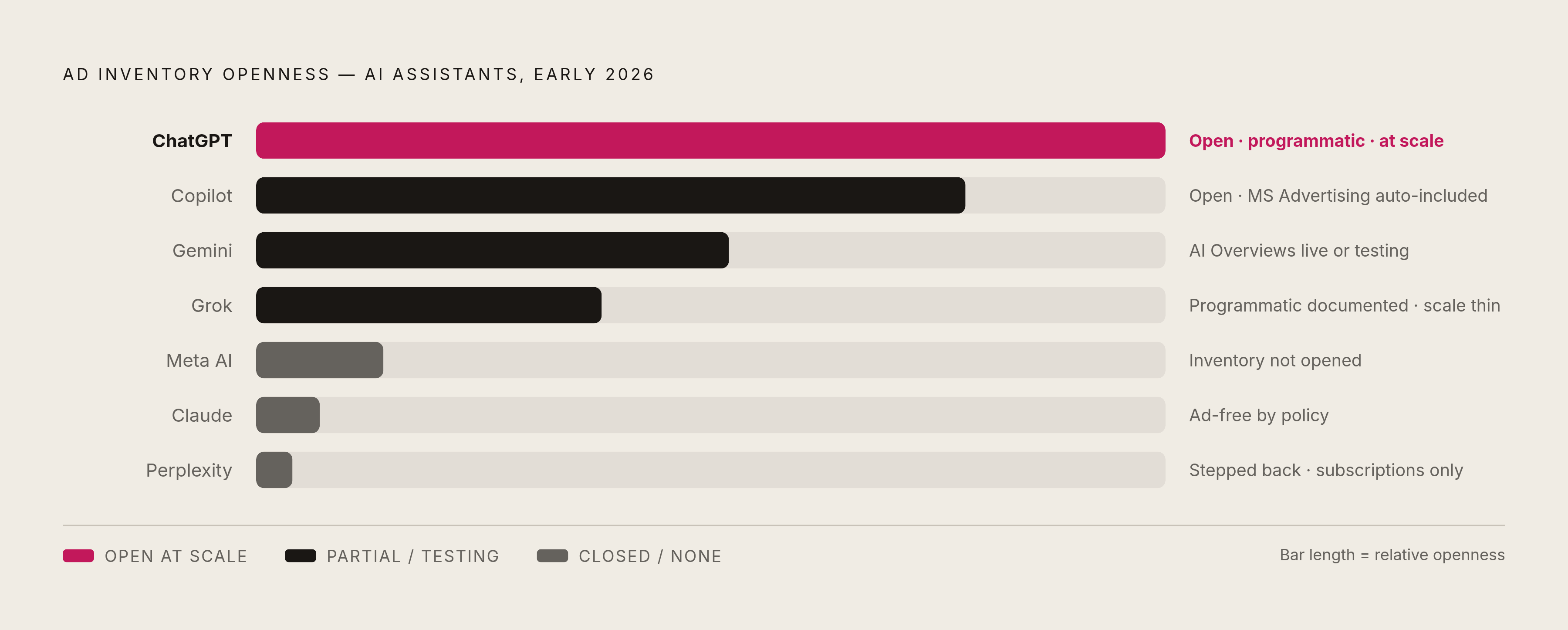
ChatGPT is the only AI assistant running open, buyable programmatic advertising at any meaningful scale today. Perplexity stepped back from ads entirely, so a DSP checklist built around "ChatGPT and Perplexity" is comparing a live market to one that no longer exists in the form buyers assume.
Perplexity's exit wasn't a product failure, and it wasn't a sign that advertisers had no interest. A Perplexity executive told the Financial Times that sponsored answers would cause users to doubt the entire answer environment: "a user would just start doubting everything … which is why we don't see it as a fruitful thing to focus on right now." Perplexity chose subscriptions and enterprise deals over ad revenue, because it judged that the trust cost of a sponsored answer sitting next to a factual one wasn't worth what advertising would bring in.
The rest of the landscape sorts cleanly along the same line. Claude is ad-free by Anthropic policy, but the company has left the door open to revisiting that stance. Gemini's own app inventory remains unconfirmed, even as Gemini-powered AI Overviews and AI Mode already carry live or testing ad placements. Copilot has opened general inventory, and eligible Microsoft Advertising campaigns are automatically included as of early 2026. Meta AI has not opened general inventory. Grok, running inside X, has documented programmatic inventory and early ad integrations, though scale and return data remain thin. Set against that field, ChatGPT stands alone as the surface with a built, buyable ad system behind it, and the checklist that follows is written for that reality.
How ChatGPT advertising works, mechanically
OpenAI separates ad serving from response generation by design. The model writes its answer on its own, and only after that answer is complete does the advertising system decide what, if anything, to show alongside it. Fidji Simo, OpenAI's CEO of Applications, put it directly: "Ads will not influence the answers ChatGPT gives you." That separation matters to anyone evaluating a DSP, because it sets the boundary on what targeting signals are even available: a buyer can reach a conversation, but cannot shape what the model says within it.
Privacy protections run through the same architecture. OpenAI keeps conversation content away from advertisers and will not sell it, and it reports performance mostly in aggregate, not at the individual level. A 2026 update to OpenAI's privacy policy added limited user-identifier sharing with marketing partners and a Conversions API that broadens what buyers can measure, but the content of a conversation and the identity behind it stay out of reach for advertisers. OpenAI's own help documentation states that if you turn off ad personalization, you will still see ads based on the context of the current chat thread, just without other chat history, ad interactions, or topic data folded in. That single sentence describes the whole targeting model in miniature: context first, history second, and a user-controlled line between them.
The auction itself has moved past an early testing phase. What was once described as a loose "proto-auction," a holdover from before self-serve buying launched, has matured into a relevance-weighted, second-price auction that supports both CPM and CPC bidding, with mechanics that look a lot like Google Ads. Buyers coming from search or display will recognize the bidding logic. What's new is what gets bid on: a conversation's topic, not a search query or a browsing history.
The DSP Access Stack for ChatGPT Inventory
Buying into ChatGPT isn't open-exchange programmatic in the way buying a banner ad through an ad exchange is. OpenAI keeps control of ad delivery and placement inside its own systems, which splits the stack in two: a buying and campaign-management layer that can run through a partner platform, and a placement layer that OpenAI alone governs.
OpenAI has built a partner network on top of that split. Agency partners include Dentsu, Omnicom, Publicis, and WPP. Technology partners include Adobe, Criteo, Kargo, Pacvue, and StackAdapt, each giving buyers a different entry point into the same underlying inventory.
The most consequential expansion of that access so far is Amazon's pilot program, which lets select U.S. advertisers extend campaigns from Amazon DSP into ChatGPT. Delta Vacations is a named early participant, and the choice of a travel brand is instructive: travel planning is a category where a single conversation often moves from exploration to comparison to purchase consideration without the user ever leaving the thread, which makes it a natural test case for ad delivery inside a chat interface.
The pilot also shows the limit of what a familiar buying tool can solve. Amazon DSP lowers the operational barrier to testing ChatGPT inventory, since teams already running campaigns through Amazon can extend into ChatGPT without learning a new platform. Amazon provides the buying and campaign-management layer, but OpenAI still decides placement, so how easy a campaign is to activate and how clear its aftermath is stay two separate questions. The Amazon pilot captures that friction well: a familiar interface reduces the work of getting a campaign live, but the control split means the buyer still can't fully see what drove a given placement decision or tune a campaign against the conversational signals that produced it. If a DSP has its own direct publisher relationships and its own exchange infrastructure, it can close part of that gap: ease of activation paired with real visibility into why an ad matched a given conversation. One example of that approach is a platform built specifically for conversational AI inventory, not adapted from display or search tooling, and built to read live prompt context directly instead of retrofitting keyword or cookie-based targeting onto a chat interface.
For every platform without open inventory, Perplexity, Claude, Gemini, Copilot, and Meta AI among them, the relevant question for a buyer is whether an earned-visibility strategy can do the job that paid placement would otherwise do.
Why a legacy programmatic checklist fails for this inventory
The targeting categories that built programmatic advertising, keyword lists, cookie-based audience segments, last-click attribution, viewability scores, standard content-adjacency brand safety checks, were designed for a web made of pages. ChatGPT has no page, rarely a keyword in the traditional sense, and often no click. A checklist built on those categories doesn't just under-perform here. It measures things that don't exist in this environment and misses the things that do.
Attribution is the clearest example of a problem still unsettled. When a campaign is bought through Amazon DSP but placement is governed by OpenAI, responsibility for targeting accuracy, brand suitability, pacing, reporting, and dispute resolution splits across two systems that don't share a single source of truth. No agreed standard yet exists for tracing a ChatGPT ad impression through to a downstream conversion. Evaluating a DSP today means evaluating a measurement discipline still under construction.
Familiar dashboards make that gap easy to miss. A team running campaigns through Amazon DSP will see the same reporting interface it already knows, and that familiarity can look like proof that the underlying measurement is just as solid, but it isn't. Assisted-conversion tracking, brand mention monitoring, and holdout testing, the tools conversational inventory actually needs, belong to a different measurement discipline than the attribution models built for search and display, and a DSP's evaluation has to test for that discipline directly rather than assume it from a dashboard's appearance.
What a DSP evaluation checklist for conversational AI inventory needs to cover
A checklist suited to this inventory has to organize itself around five questions, because legacy programmatic evaluation never had to ask them. Whether the DSP can read conversational context, how it accesses publisher-direct supply, what intent-signal targeting it offers beyond keywords and audience segments, how it handles the control split between buying and placement, and what measurement approach it supports once last-click attribution stops working, these five questions form the spine of the evaluation, and each deserves a direct answer from any vendor under consideration.
On context-reading, a buyer needs to ask whether the platform can target the topic of an active conversation rather than falling back on a user profile or a keyword match, and whether it reads multi-turn context, recognizing that a user four exchanges into a specific problem is a different signal than a single isolated query. A buyer should also ask whether the platform suppresses ads in sensitive conversations, keeping them out of exchanges where a user is emotionally reliant on the assistant or discussing a mental health concern, since that kind of context never comes up in a search query or a page view the way it does inside a chat thread.
On supply access, ask whether the DSP has direct relationships with AI publishers or only reaches conversational inventory through intermediaries and resellers, and whether it can run its own exchange and SSP infrastructure instead of buying through someone else's supply chain, because direct access changes what you can verify about where an ad actually ran. The supply path itself should be auditable: authorized sellers, sellers.json checks, and clear deal IDs for premium conversational placements are the kind of transparency a buyer should expect to see, not infer. Amazon DSP's approach is instructive here: it bundles ChatGPT access, through its limited U.S. pilot, into a broader supply portfolio that already includes Netflix, Roku, Spotify, SiriusXM, and Disney (which brings in Disney+, Hulu, and ESPN through its DRAX integration). That bundling gives a buyer reach and convenience, but it doesn't by itself deliver the contextual precision or the direct publisher relationship that conversational inventory rewards, which is a separate capability a buyer has to check for on its own terms.
On intent signals, the question is whether the platform targets what a user has actually said, declared intent stated in plain language, rather than an inferred audience segment or a keyword adjacency guess, and whether it offers something like intent-quality scoring, weighting a placement by how deep and specific the conversation is rather than by the mere presence of a topic. It should also be able to exclude categories of conversation where a commercial placement would feel out of place, a finer distinction than the content-category brand safety checks legacy programmatic relies on.
On the control split, a buyer needs to know, concretely, which party holds authority over targeting parameters, brand suitability enforcement, pacing, and reporting when the DSP isn't the system running the auction, as in the Amazon DSP and OpenAI arrangement. There should be a defined escalation path for what happens when a placement violates a brand safety rule set inside the DSP but carried out by a separate placement system, and the buyer should ask directly whether the platform gives it access to OpenAI's brand safety controls, including topic exclusion lists, category-level blocklists, age-gated content controls, sensitive-conversation suppression, conversation-context filters, and third-party verification.
On measurement, the platform should support assisted-conversion tracking, brand mention monitoring, and holdout testing as a matter of course, not last-click attribution alone, and it should give the buyer log-level data so the source of truth on performance sits with the buyer rather than the platform. It should also integrate with or support third-party verification from partners such as DoubleVerify or Integral Ad Science, even when those partnerships are still being built out and not yet fully live.
Brand safety, verification, and the responsible advertising standard for conversational placement
OpenAI's own Ad Policies describe safeguards across two categories: protections for sensitive user contexts and exclusions for brand-unsafe contexts, including harmful, political, and other regulated categories, along with age-based ad suppression for minor accounts. No confirmed partnership with DoubleVerify or Integral Ad Science exists yet. These documented protections set the floor that any DSP partner has to be able to surface and enforce on a buyer's behalf, regardless of what additional verification arrives later.
These controls exist on OpenAI's side, and that part is already documented. It's whether the buying platform actually gives the advertiser access to them, and what recourse exists when a placement crosses a boundary that was set inside the DSP but carried out by OpenAI's own systems. If you can't answer that second question, you haven't finished evaluating the DSP, no matter how complete the first answer looks.
Sensitive-context suppression deserves separate attention from standard content-category brand safety, because the two are solving different problems. A search results page or a display placement never has to account for a user mid-disclosure about a mental health crisis or an emotionally reliant exchange with an assistant, but a conversational interface exposes that kind of context in nearly every session. If a brand safety framework only checks the subject-matter category of a conversation and never checks for emotional vulnerability within it, it is solving yesterday's problem with yesterday's tool. Any DSP evaluation for this inventory has to test for that distinction directly, because the personal nature of a chat conversation raises the bar past what content-adjacency checks were ever built to catch.
What earned visibility on Perplexity requires
Perplexity's absence from the paid side of this checklist doesn't mean it drops out of the planning conversation. So the route to visibility there runs through answer engine optimization, not media buying. A brand that wants to appear in a Perplexity answer has to earn that placement the way it would earn a featured snippet or a strong organic search result: by producing the kind of structured, authoritative, well-sourced content that an answer engine's retrieval system favors when it assembles a response.
That earned-visibility work belongs beside the paid checklist built for ChatGPT, not apart from it. When a brand runs paid campaigns against conversational context on ChatGPT and also builds the content signals that drive citation on Perplexity, it is meeting the same underlying need, visibility inside an AI-mediated conversation, through the two different mechanisms now available for pursuing it. Treating them as a single planning problem, rather than two unrelated initiatives run by different teams, is what keeps a brand's AI visibility strategy coherent as the field keeps shifting. Given how quickly Copilot, Gemini, and Grok have moved on their own ad inventory in the span of a year, the platforms currently closed to paid placement won't necessarily stay that way, and a brand that has already built strong earned visibility on Perplexity will be better positioned if and when that changes.