Ad Creative Adaptation Across Multiple AI Surfaces
Creative that works in ChatGPT fails in Perplexity—and vice versa.

Ad creative built for one AI surface breaks when it's dropped into another. Inline cards, sidebar panels, sponsored chips, and response-grounded mentions each impose their own rendering rules, their own latency budget, and their own relationship to user trust. Advertisers treating this like a resizing job, shrink the banner, trim the copy, ship it, are the ones watching CPMs compress and click-through rates stall. Industry projections show standalone chatbot ad spending climbing sharply next year, with a larger adjacent opportunity sitting in AI search-adjacent formats. Most creative teams are still treating the two like one channel, and that mistake is costing them money they can actually count.
What makes an AI surface different from a digital ad placement
A banner ad lives on a page. The slot is sized and positioned before a single user shows up, and it exists regardless of whether anyone visits. An LLM ad slot doesn't exist until a prompt creates it. The user types a question, and the system decides in real time if that question opens a commercial opportunity; only then does anything resembling an "ad placement" come into being.
That decision runs through two layers. First, the fetch layer determines which ad matches the intent behind the prompt and confirms it can retrieve that ad inside the latency budget. Second, the render layer decides where and how the ad gets drawn inside the chat interface. Each layer fails differently. Block the model's answer while it waits on an ad fetch, and the whole product feels broken. Misread the intent at the trigger stage, and the ad becomes irrelevant, or worse, jarring against the tone of what the user just asked.
None of this looks like a search ad sitting above a list of blue links, or a banner anchored to a URL. An LLM ad is contextual to the current turn of a conversation. It has to match the register of that exchange and the intent visible in it at that exact moment, not five minutes earlier and not in general. Latency, here, isn't a backend concern handed off to engineers. Sources describe a hard timeout in the 200 to 300 millisecond range, after which the interface just commits to showing no ad that turn. A creative asset too heavy to fetch and render inside that window doesn't get penalized. It does not appear at all in that turn.
Targeting doesn't run on the old inputs, either. There's no cookie trail, no demographic bucket, no six-months-of-browsing-history model here. It runs on semantic understanding of what the user just said and what they plausibly want next. That shift changes what a creative has to say and how fast it has to say it.
What each of the four surfaces in production demands of the creative
Four formats are live or in active testing right now, and they don't ask the same thing of a creative team.
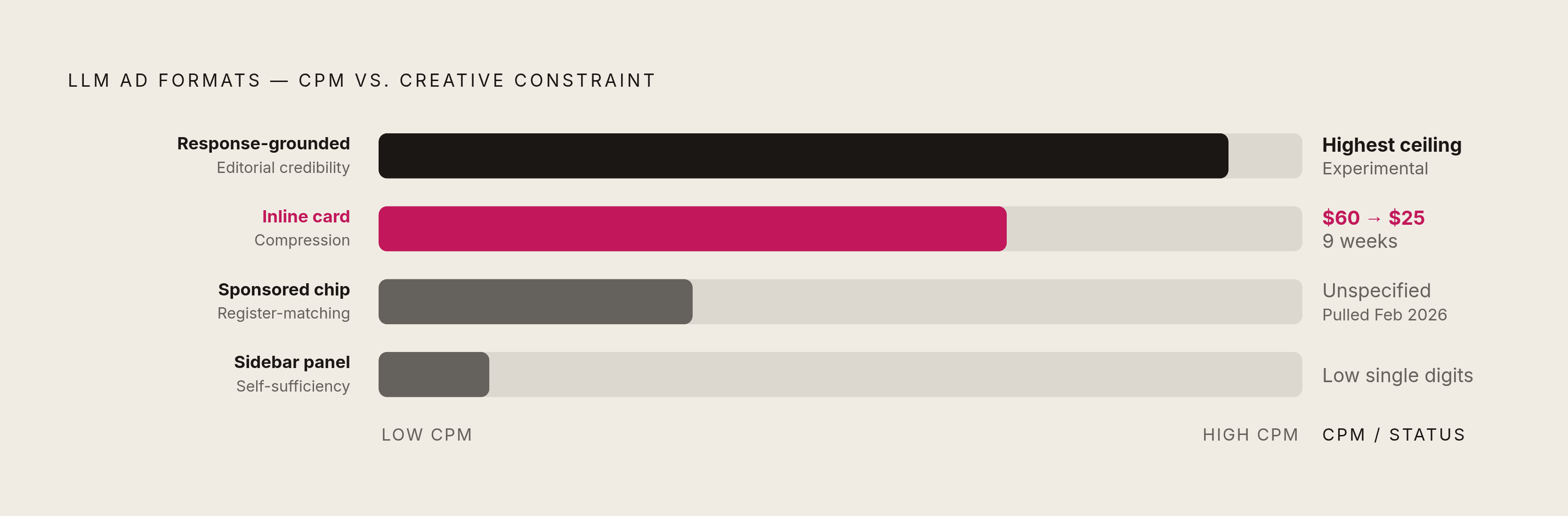
The inline card loads in parallel with the model's response stream and appears once both the answer and the ad object have resolved. It's the format OpenAI picked for its February 2026 ChatGPT ads pilot, for good reason: highest yield, lowest UX risk of the current options. But the creative brief here is narrow. The user has already read a full answer, so copy that just restates what the model said earns banner blindness faster than any other format on this list. CPMs prove the point: ChatGPT inline ad pricing opened around $60 and fell to roughly $25 within nine weeks, a drop that suggests the format's economics hinge on creative differentiation, not on where the pixel sits.
The sidebar panel is a different animal. It sits outside the conversation column, exists on desktop and not on mobile, and persists across multiple turns rather than appearing once. Impression counts run high, attention per impression runs low, and CPMs are in the low single digits, closer to conventional display pricing than to the inline card's range. Because there's no conversational scaffolding to lean on, the creative has to work as a standalone unit, closer in spirit to a display banner than to anything native. Branding and visual identity carry more weight than copy does here. This format fits desktop-first workspace tools built in a Copilot-style mold. It's the wrong choice for a mobile-first consumer app, and advertisers who port sidebar creative straight into a chip or a card are making the same error in reverse.
The sponsored follow-up chip is the most fragile of the four. These are the suggestion pills that appear below an answer, and clicking one either submits a brand-favorable prompt back into the conversation or routes the user out to the advertiser. Perplexity shipped this format in November 2024, then pulled back from advertising altogether in February 2026, citing concerns about user trust. The format itself causes the problem: users read "you might also ask…" chips as product signals, not ad signals, so a sponsored chip feels like influence even when the underlying answer never changed. The creative brief here asks for something close to a contradiction, copy that reads exactly like an organic follow-up question while also carrying a clear sponsor label. That tension is why Perplexity walked away from it, and any team still building for this format should treat that exit as a warning, not a data point to ignore.
The response-grounded brand mention is the furthest out and the riskiest. It weaves a brand or product directly into the body of the assistant's generated answer. Still early-stage, still mostly experimental, but the revenue ceiling is the highest of the four formats, and so is the UX cost. OpenAI's published ad policies require clear labeling and a firm line between organic answers and paid placement, so a mention that blurs that boundary runs directly against those stated requirements. This format remains largely experimental today, but it shows where the format is heading.
Four surfaces, four different creative registers, four different relationships to the answer that came before the ad. Treating them as interchangeable slots is the first mistake, and it's the one most teams are still making.
How trigger logic shapes what the creative needs to say before a user sees it
Every surface starts by answering the same question: is this prompt commercially relevant? That single judgment decides if an ad fires, which ad fires, and what assumptions the creative gets to make about the state of mind of the person reading it.
Trigger logic reads the current conversational turn semantically. It isn't matching keywords, and it isn't consulting a demographic profile built last quarter. That has a direct consequence for how copy gets written: the ad doesn't need to build awareness of a problem, because the user's own prompt already stated the problem. The creative's real job is narrower and harder than that, to be the most credible next step available.
Different prompts call for different registers. A comparison prompt, something like "what's the best X for Y," wants a creative that resolves the comparison rather than reopening it with more options. A how-to prompt wants a creative that extends the answer with a specific product or service that makes the task in front of the user easier, and it wants that instead of a generic pitch. A prompt that reads as a struggle, "I'm having trouble with X," calls for empathy before any offer. Lead with the sale there and the ad reads as tone-deaf.
Verve Group's March 2026 launch of conversational intent signal targeting, billed as the first open-market platform to operationalize high-fidelity intent data pulled from AI chat interfaces, processes over a billion signals daily. That scale matters less as a headline number and more as proof of how much information sits at the trigger layer before any creative asset even loads. The practical implication for a creative team is that variants should map to categories of prompt intent as well as to surface type. A comparison, a how-to, and an open-ended question generate different copy needs for the same inline card slot, because the prompt sets the intent, and that intent determines which copy approach applies.
Why a single creative brief cannot serve multiple AI surfaces
The instinct to repurpose is understandable. Build one strong creative for the inline card, resize it for the sidebar, chop it down into chip copy, call the job done. That instinct is wrong, and the mechanics of each surface show why.
An inline card follows a complete answer, so its copy has to add something the answer didn't already cover. A sidebar panel sits beside a conversation the user is still mid-way through, so its creative has to stand on its own with zero conversational context to lean on. A chip doesn't sit next to the conversation, it becomes the next turn of the conversation, so it has to read like a real question a person would ask, not like a headline wearing a question mark. A response-grounded mention lives inside the answer's own prose, so it has to be factually accurate and editorial in tone, not promotional.
The four-layer LLM ad stack described in the Lapis guide from June 2026 makes a useful point here: demand, context, and measurement are largely handled by the platforms themselves. Creative is the layer advertisers actually build, and it decides if a campaign works. That job gets harder, not easier, when the underlying data stack is already fragmented. Research cited in that same guide, from Salesforce's State of Marketing report, found the average marketer stitching together roughly ten separate data sources just to build one view of a customer, with only 31% satisfied with their ability to unify them. Bolt four more surface-specific creative variants onto a data stack that's already stretched thin, without a real process behind it, and the fragmentation compounds instead of resolving.
Surface-specific adaptation is the floor beneath a normal campaign, not an extra layer of work stacked on top of it. Surface-specific adaptation is the floor, not an extra layer of work stacked on top of a normal campaign. The format constraints and the user's conversational state are the two variables that decide if an ad earns attention or breaks trust, and neither one holds still across surfaces.
What adaptation requires: process, variants, and latency-aware assets
Treat the surface's constraints as the creative brief itself, applied from the start of the concept rather than after it is done. The inline card wants short copy, made up of a title plus one or two sentences, a clear sponsor label, and a link. The constraint is compression. The sidebar wants a standalone visual and headline that hold up with zero conversational context; the constraint is self-sufficiency. The chip wants five to ten words in question form, and the constraint there is matching register exactly. The response mention wants prose that's accurate, disclosed, and stitched into the answer without breaking its voice, and the constraint is editorial credibility.
Volume matters as much as format. Because trigger logic fires against a wide spread of prompt intent categories, one creative variant lands as a mismatch most of the time it appears. The guide describes automated creative production as capable of generating substantially more variations per cycle than manual production allowed, and for LLM advertising that capacity stands as a baseline requirement for staying relevant across the range of prompts a single surface can trigger against.
The architecture behind affiliate and commerce surfaces splits the job in two, according to reporting on how these systems are built. The language model handles the conversation and the reply text, while a separate rule-based pipeline handles product extraction, catalog matching, ranking, attribution, and link rewriting. Creative adaptation has to plug into that split rather than assume one monolithic system handles everything end to end.
Formats keep multiplying, too. A DSP built for LLM environments launched four native ad formats in June 2026 aimed specifically at conversational settings: inline cards, branded follow-up prompts, carousels, and interactive polls. Carousels and polls inside a chat window say something on their own: the creative surface is expanding well past static text cards, and any adaptation process built today needs room for formats that don't exist yet.
A working checklist for each surface, before anything ships. Does the asset resolve inside the latency budget? Is the copy register matched to the conversation it's dropping into? Does it add something the preceding answer didn't already say? Is the disclosure clear without crowding out the creative? Is there a distinct variant built for each major prompt intent category that can trigger this surface?
How performance signals from each surface should feed back into the adaptation process
Last-click attribution doesn't work in a conversational interface, because the user's decision path runs through dialogue, not through a trackable sequence of URLs. That's an unsolved problem, not a minor gap, and any team pretending otherwise is measuring the wrong thing.
Some early numbers exist, and they need careful reading. Microsoft has reported that ads shown inside Copilot experiences generate 69% higher click-through rates and 76% higher conversion rates than traditional search ads. Those are platform-reported, early-stage figures, and the creative conditions that produced them aren't disclosed anywhere. Performance data from a given surface has to get read at that surface's level, not folded into some blended average across every placement a brand runs.
Legacy-channel data offers a useful, if indirect, signal. Benchmark data found AI-generated ads pulling roughly 12% higher click-through rates than human-made ads on Meta. But conversion rates for those same AI-generated ads dropped 8% on purchases above a $100 average order value, and that gap widened to 14% above $500. AI creative wins attention easily but struggles to close higher-consideration purchases in a traditional feed. Conversational surfaces, rich with expressed intent in a way a Meta feed simply isn't, may close that exact gap. That's a hypothesis, not a finding, and testing it means building measurement at the surface level from day one.
StackAdapt's internal platform data found campaigns using dynamic creative optimization delivering a 32% higher click-through rate than static creative. The underlying principle, that creative matched dynamically to context beats creative that doesn't bother to match anything, is the same logic driving the case for surface-specific LLM adaptation. It also gives creative teams a real argument for the variant volume this channel demands: tag every variant by surface and by prompt intent category, not just by campaign name, and the feedback loop finally has something to learn from.