Frequency Cap Setup and Conversation-Level Reach Control
Conversations demand different frequency caps than feeds do.

Frequency capping used to mean one thing: cap the number of times a cookie sees an ad in a rolling window, and move on. Conversational AI breaks that model, because the unit being capped is no longer a page view or a session. It's a conversation, and a conversation behaves nothing like a feed.
Frequency cap units and windows in legacy programmatic, and their breaking points
The standard formula hasn't changed much in fifteen years: N impressions per user, per day, week, or campaign lifetime, tracked at the cookie or device-ID level. DV360 lets advertisers set caps at the insertion order, line-item, and creative level, and supports recency capping so a user doesn't see the same creative twice in a short span. Meta's controls sit differently depending on the objective. The frequency cap field only shows up on Reach and Brand Awareness campaigns. Sales and Conversion campaigns have different frequency controls with their own constraints depending on campaign setup. Advantage+ campaigns skip manual frequency control entirely; delivery runs on Meta's algorithm, and advertisers are left nudging it indirectly through budget and creative rather than setting a hard number.
The research behind these caps is fairly settled. Roughly 80% of an ad's impact is in the first two exposures. Nielsen's work on effective frequency puts the peak somewhere between three and five exposures, after which returns decline. Click-through rate tends to fall by half once a user has seen the same creative five to eight times. None of this is controversial. Funnel stage matters so much in how caps get set because of this. Cold prospecting usually calls for a cap around two to three impressions. On Meta, capping frequency at twice a week captures something like 95% of the purchase-intent lift that's available at all, so chasing four-plus exposures rarely buys anything beyond the wasted spend.
All of this logic assumes a stable, countable unit: an impression, tied to a session, tied to a rolling clock. Conversational AI doesn't offer that unit.
Structural differences of a conversation as an ad-delivery context
A chatbot user is mid-task. They're asking a question, working through a problem, or planning something, and they're paying attention in a way a scrolling feed user usually isn't. That changes what an ad costs when it lands wrong. In display, users have spent two decades learning to tune out banner ads, and roughly 81% of consumers in one surveyed market say they try to ignore or tune them out anyway. Recent industry survey data shows consumers say they try to ignore or tune them out anyway, and 52% go further, actively blocking ads. Chatbot users haven't built that callus yet, and an ad that feels out of place in a conversation doesn't just fail to convert. It damages trust in the assistant itself, not only the brand behind the ad. That's a different kind of cost, and it's a much harder one to reverse: once a user starts doubting whether the assistant is working for them or for an advertiser, regaining that trust in future sessions is a slow climb that may never fully happen.
A conversation also has no fixed length. There's no page view to count, no scroll depth, no natural ad slot the way a sidebar or a mid-feed placement has trained users to expect. And a conversation is sequential in a way a page never is: each message builds on the last, so an ad at message three and an ad at message twelve of the same thread aren't equivalent exposures, even with identical creative. One arrives early, when the user's intent is still forming. The other arrives deep into an exchange that's already established its own context and expectations. Treating those as the same "impression" throws away information a legacy cap never had to account for.
Defining conversation-level reach control
Conversation-level reach control caps how many ad touchpoints appear inside a single conversation thread, counted in turns rather than minutes. This distinction affects how ad exposure is measured and controlled: a conversation-level cap ties frequency limits directly to actual engagement depth rather than elapsed time. A 30-minute session window tells an advertiser nothing about whether the user sent three messages or forty; a conversation-level cap ties directly to engagement depth, which tracks user experience far more closely than a clock does.
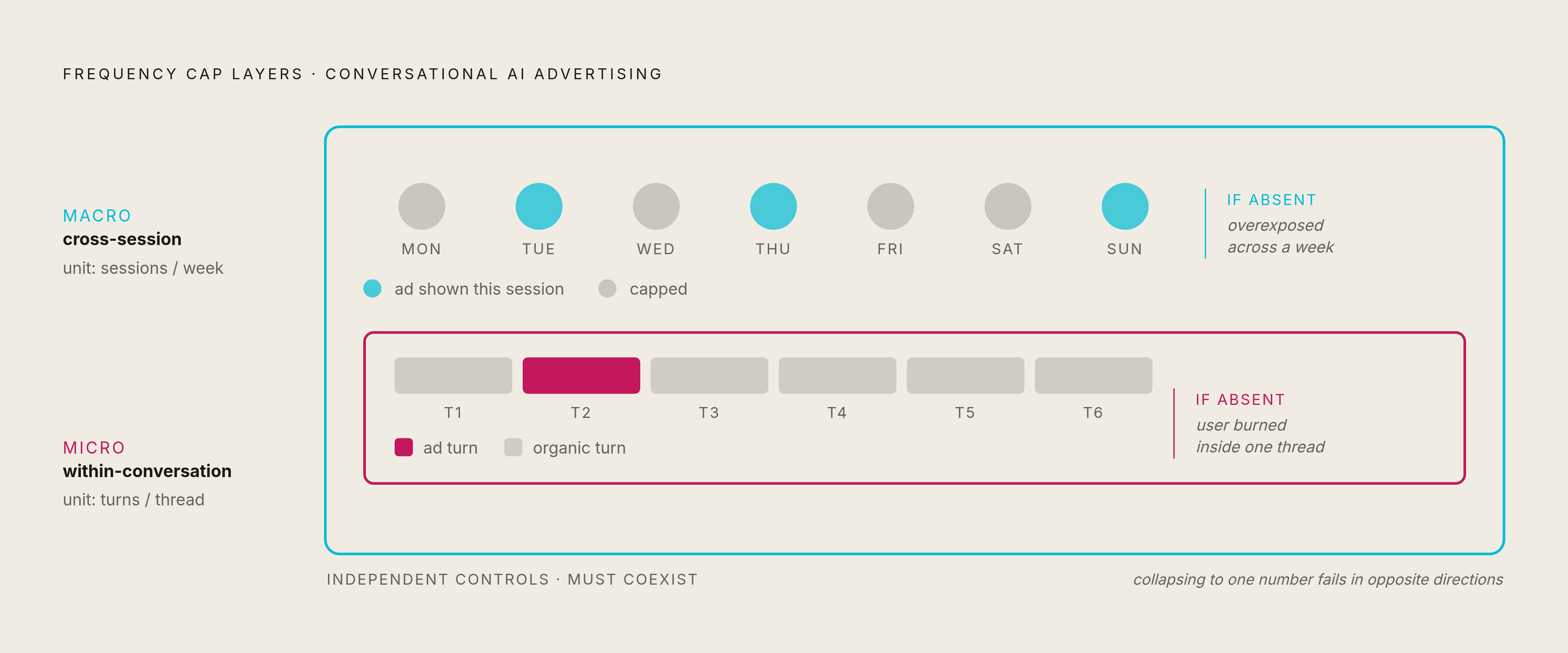
It's also a different thing from a per-day or per-week user-level cap. Those govern reach breadth: how often a person runs into a brand across separate sessions over some period. Conversation-level caps operate at a smaller scale entirely, governing density and placement inside one exchange, where the risk isn't overexposure across a week but repetition inside a single train of thought. Both levels have to run at once. Cross-conversation caps are measured by how often the brand appears in someone's life over time; within-conversation caps are measured by whether repetition inside a single exchange raises the risk of it feeling like it's being sold to.
The technical architecture that makes conversation-level caps enforceable
Enforcing a conversation-level cap takes three layers working together. A trigger layer decides whether the current prompt is commercially relevant enough to consider an ad. A fetch layer finds a matching ad and has to return it inside a strict latency budget. A render layer decides how and where that ad actually appears inside the chat interface. Frequency logic has to run across all three, because a cap that's only checked at fetch time does nothing to stop a trigger layer from firing on an already-capped brand.
None of that works without a ledger sitting outside the model itself: a database tracking which ad units, creatives, and brands have already shown up in the current thread, and across the same user's prior sessions. Language models are stateless by design, generating each response fresh, so that external ledger is what turns a stateless system into one that can actually remember it already showed you this ad twice.
Latency is the constraint that shapes all of it. Ad fetch has to run on a hard timeout, typically somewhere around 200 to 300 milliseconds, and once that clock runs out, the system has to commit to serving no ad that turn rather than retry and risk stalling the response. Blocking the answer stream to wait on an ad call is probably the single most common integration mistake in this category, and it's the one most likely to burn user trust fast, since nothing reads worse to a chatbot user than a delayed answer waiting on an advertisement.
Identity resolution runs on different rails than legacy programmatic, too. ChatGPT's targeting draws heavily on conversation history tied to a logged-in account rather than on traditional contextual signals like page URLs or keywords. That makes identity solid and persistent for users who are logged in, and considerably messier for anonymous users or people bouncing between devices, where there's no consistent thread to tie sessions together.
Interaction between targeting and bidding decisions and frequency cap logic in conversational AI
Context replaces the cookie as the targeting unit. ChatGPT's ad matching, based on its 2026 launch mechanics, draws on the topic of the current conversation, past chats, and prior ad interactions rather than keywords or page URLs. Ads get matched to what the conversation is actually about, using short context hints, brief descriptions of the conversation or scene, that the underlying model uses to find a semantically relevant match. Bid eligibility is decided at the level of the prompt.
Frequency caps interact closely with the auction in this setup. If a user has already hit the cap for a given brand within the current conversation, that brand's bids get suppressed no matter how high the CPM is. How exactly that suppression is implemented relative to auction sequencing is not yet publicly specified, but the effect is that cap status gates whether a brand is eligible to compete at all.
Academic work on ad auctions inside generated text has looked at frameworks where higher bids earn more prominent placement inside an LLM's output, and at auction designs that weigh both relevance and bid value when deciding what to place inside a generated response. Frequency caps add a third variable to that mix: a brand's bid eligibility, based on what it has already shown this user.
Settings brands and campaign planners need to change when configuring caps for AI inventory
Two caps need setting, not one. A within-conversation cap governs how many touchpoints appear in a single exchange. A cross-conversation, user-level cap governs how often that same person runs into the brand across separate sessions over some defined period. Treating those as one number is the fastest way to either starve a campaign of reach or burn out a user inside a single thread.
Funnel stage determines how caps and ad surfaces should be set here, playing a bigger role than it does in display. Someone in early research mode and someone actively comparing options mid-conversation are not the same audience, even if they'd land in the same retargeting segment in a display campaign. The within-conversation cap, and the surface chosen to serve the ad, should shift based on where the user sits in that intent curve and which audience segment they were bucketed into.
Creative rotation carries over from display, but the stakes are higher. Repeating the same creative across separate days in a display campaign barely registers with most users. Repeating the same creative inside one conversation is obvious, and it reads as patronizing in a way a banner ad simply can't, because the user is actively engaged with the surrounding text and notices repetition immediately.
The inline card placement, among the formats running since ChatGPT's February 2026 ad launch, represents the highest-yield, lowest-risk surface in production right now, and it's the surface around which most within-conversation cap logic should be built. Sidebar and chip-style formats carry their own UX tradeoffs and their own risk profiles, and they call for separate cap treatment rather than being folded into the same rule set.
What remains genuinely unsolved in conversation-level frequency measurement
Identity fragmentation is the biggest open problem. Frequency enforcement depends on recognizing the same person across conversations, devices, and platforms, and in a world built deliberately without cookies or device fingerprinting, cross-surface identity resolution doesn't have a clean answer yet. It's a genuinely open question.
Defining what actually counts as one conversation is just as unresolved. A user who closes a thread and reopens it later, or switches devices mid-task, or picks a topic back up in a fresh session, may still be mid-conversation in intent even though the system logs it as something new. There's no industry standard yet for where a conversation boundary actually sits.
Attribution is harder still. Tying an ad shown at message four of a thread to a conversion that happens two days later, on a different channel entirely, is a tougher problem than even multi-touch attribution in display ever was. Measurement inside assistant-mediated discovery is unsolved in the plain sense of the word: nobody has a clean answer yet, and it isn't for lack of trying.
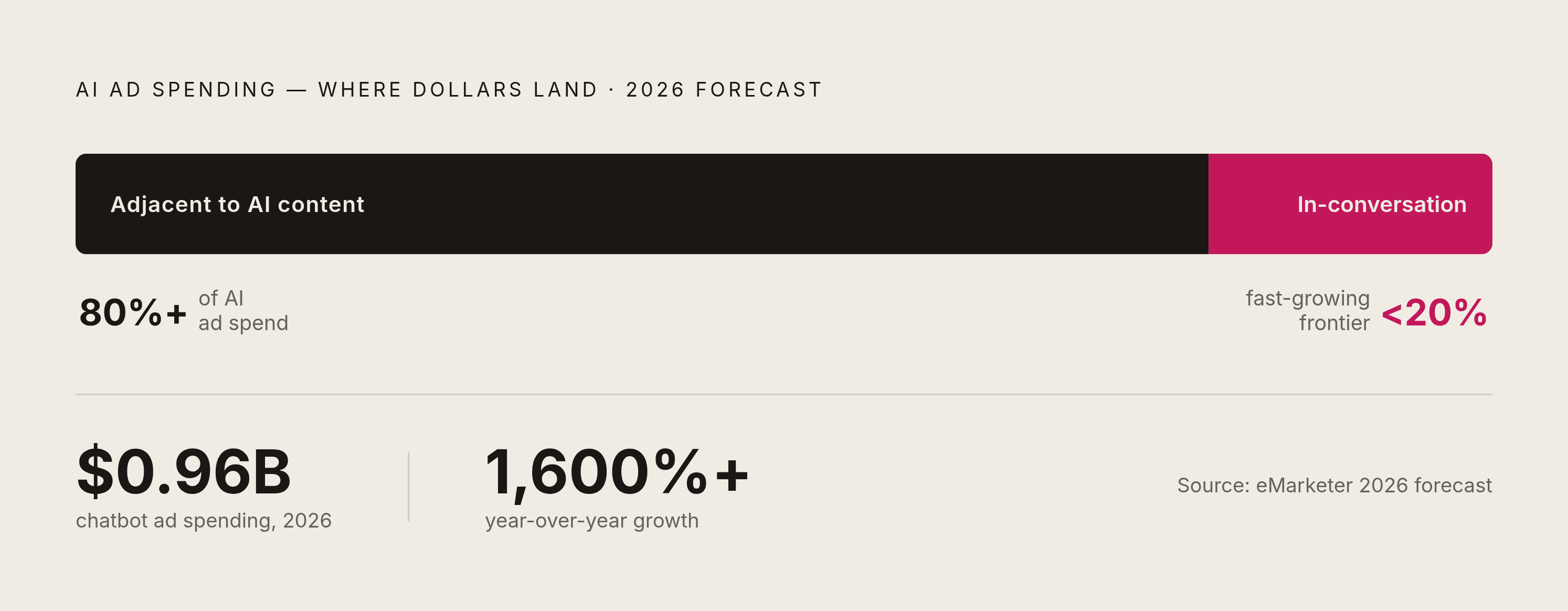
And the core tradeoff between reach and trust still has no agreed calibration. eMarketer forecasts standalone chatbot ad spending at $0.96 billion in 2026, up more than 1,600% year over year, a genuinely startling growth curve. Yet the same forecast notes that over 80% of 2026 AI ad spending still runs adjacent to AI-generated content rather than inside actual chatbot conversations. The in-conversation format is growing fast, but the norms for how hard to push that inventory, how many touchpoints a thread can absorb before trust starts to erode, are still being written by the industry as it goes.