Native Ad Formats vs Display Formats Inside AI Interfaces
Conversational ads need native formats, not display banners that break the chat.
ChatGPT crossed 1 billion monthly active users faster than TikTok, YouTube, or Instagram did, according to Sensor Tower's State of AI 2026 report. That single fact should end the argument over whether ad formats inside AI matter yet. They do, and the interface those billion users sit inside doesn't work like anything advertising has been built for over the past twenty years. Global time spent on generative AI apps is projected to hit 36 billion hours in the first half of 2026, up from 17.2 billion hours the same period last year. ChatGPT alone holds users for about 215 minutes a month and processes 2.5 billion queries a day as of July 2025, each one a stated expression of intent rather than a guess pieced together from browsing history.
Scale isn't the interesting problem here, and treating it as the headline is where most of the industry's thinking has gone wrong. The format question inside AI is structural, and getting it wrong costs far more than a few points of click-through rate. It breaks the product. Display advertising, dropped into a conversational interface without rethinking what it's for, degrades the thing users came for in the first place. That's the position this piece takes, and the platforms that have tried display inside chat, even briefly, have already found the ceiling on it.
What makes an AI interface structurally different from a web page or social feed
A web page or a social feed is arranged in parallel. Content sits in one place, an ad sits beside it or below it, and a user's eyes move between the two on their own terms. Nothing mechanically interrupts anything else. That's the entire logic banner ads and feed ads have run on since the format existed: proximity without intrusion.
A conversational interface offers less of that proximity. It's sequential and turn-based. A user asks, the assistant answers, the user responds to that answer, and the loop continues. There's no scanning two things at once, because there's only one thing on screen at a time, the current turn of the conversation. The trust architecture is different too. Users don't treat a ChatGPT or Copilot response the way they treat a page of search results, where sponsored links sit in an expected, roped-off slot. They treat the response as a synthesis already arrived at, not a shelf of options they're meant to sort through themselves.
Intent shows up differently as well. A prompt is a stated problem. Someone typing "what's the best project management tool for a five-person design team" leaves behind far fewer inferred signals than a browsing session does. They're just saying what they want. And because conversations accumulate, a follow-up prompt builds on what came before it, so the system isn't reading a single moment of interest, it's reading a trajectory.
None of this leaves margins to work with. There's no sidebar, no header, no chrome to tuck a display unit into without it landing inside the answer itself. That absence of margin is the whole ballgame.
Why display formats break inside conversational AI
Display advertising assumes visual separation between the ad and the content, and it assumes the user's attention moves between the two by choice. Neither assumption survives a turn-based interface, because there's no "beside" to place anything in. A banner inside a chatbot doesn't sit next to the answer. It sits inside the flow of the answer, or it interrupts the beat right before or right after the answer lands.
Amphora's analysis of the problem states that a flashing banner inside a chatbot doesn't just annoy a user, it shatters the illusion of a helpful, intelligent assistant, which is the exact relationship the whole interface depends on. Banner blindness is already a settled fact of digital life, and GWI's Q2 2025 data puts global ad-blocking at 29.5% of internet users, roughly 1.77 billion people who tune banners out at least some of the time. Inside a chat interface, that same instinct doesn't show up as a blocked ad. It shows up as an abandoned prompt, or a user who quietly stops trusting the tool.
Perplexity's own experiments are instructive here, because the company actually tried to make display work rather than dismissing it. Alongside its native formats, Perplexity ran what it described as traditional banners "woven into" the interface. Even there, display stayed a secondary, tucked-in unit rather than the centerpiece, which says something about where even a company betting heavily on ads inside AI thought the format actually belonged. This is an argument that display outperforms on click-through rate is not being made here. It's an argument that display actively degrades the product experience, and that damage shows up as a broken relationship between publisher and user long before it shows up in any performance report.
What native actually means inside a conversational interface, and what it doesn't
EMARKETER defines native advertising, in traditional digital media, as paid content designed to match the look, feel, and function of the media format where it appears. That definition assumes an editorial environment sitting around the ad. A conversational interface doesn't have one. The environment is the conversation itself.
So native inside AI means something narrower: the ad matches the form and function of the assistant's own response. Useful, direct, relevant to the prompt actually in progress, not a sales pitch borrowing the assistant's voice.
Worth separating from a few things it gets confused with. Conversational commerce, the idea from around 2016 of running a sales interface inside a chat window, is a different animal. AI-generated ad creative, tools that produce ad designs using generative models, is a production tool, not a placement format. And a search ad running beside an AI-generated summary is an ad beside the AI's output, not an ad living inside the conversation.
The real test is simple to state and hard to fake: does the ad match the specific intent the user just expressed, and does it add something rather than cut across it? Disclosure isn't optional here. Native inside AI does not mean hidden, and "Sponsored" labeling shows up on every current AI platform running ads. That's a core design priority. It's part of what makes the format work at all.
How the platforms that run ads inside AI have implemented native formats so far
OpenAI's current standard is the chat card, a sponsored unit that appears below the AI's response rather than inside it, with a headline (16 to 24 characters recommended, 50 max) and a description (32 to 48 characters recommended, 100 max). Targeting runs on what OpenAI calls context hints: advertisers describe the kinds of conversations where their product fits, say, "users comparing project management tools," rather than bidding on keywords the way search advertising has worked for two decades. Bidding options include CPM, CPC, and an outcome-optimized model that adjusts per-click bids using predicted conversion likelihood, whether that's a purchase, a lead, or a sign-up.
OpenAI has drawn a fairly clear privacy line: advertisers don't get access to private chat histories, memories, or identifiers like name, email, or IP address, though limited identifiers such as cookie IDs and device IDs can be shared with marketing partners under the company's updated privacy policy, and users can turn off ad personalization. ChatGPT's weekly active user base, over 800 million as of the most recent figures, makes it the largest potential ad audience of any AI platform, and the ad team behind it was built with people pulled in from Google, Meta, and X. The chat card sitting below the response, not inside it, is the format respecting the turn-based structure rather than fighting it.
Perplexity took a different path, then reversed course. It launched ads in November 2024 with Sponsored Follow-Up Questions, text prompts inside the Related Questions section (a section that accounts for 40% of all queries on the platform), clearly labeled "Sponsored." Clicking one triggered an AI-authored answer written independently of the advertiser. Perplexity also sold video ads and display banners alongside those native units, the same hedge its product decisions kept revealing: even a company building native formats first kept a foot in traditional display. Early advertiser reports put Perplexity's CPMs in the $30 to $60 range, with an internal floor cited above $50, numbers that sit near the top of digital advertising generally and reflect how strong the intent signal behind a Perplexity query actually is. Perplexity has since discontinued its advertising program entirely; no ads run for any user, free or paid. Before that exit, CEO Aravind Srinivas confirmed plans to use the Comet browser to gather far more behavioral data for ad targeting, an ambition that drew real scrutiny over scope and privacy trade-offs before the company walked away from ads altogether.
Anthropic has taken the opposite stance outright, stating that ads inside Claude conversations would be "incompatible with what we want Claude to be." Claude sits entirely outside the AI advertising landscape right now, and that absence is itself a useful data point on how wide the range of platform positions has become.
Across the platforms that do run ads, the pattern holds: native-leaning formats land after the primary answer, not inside it or ahead of it. The response stays intact. Where platforms hedged toward display anyway, that was the easier sale to legacy ad buyers, and also exactly the trust risk the previous section described.
What the performance data says about ads matched to conversational intent
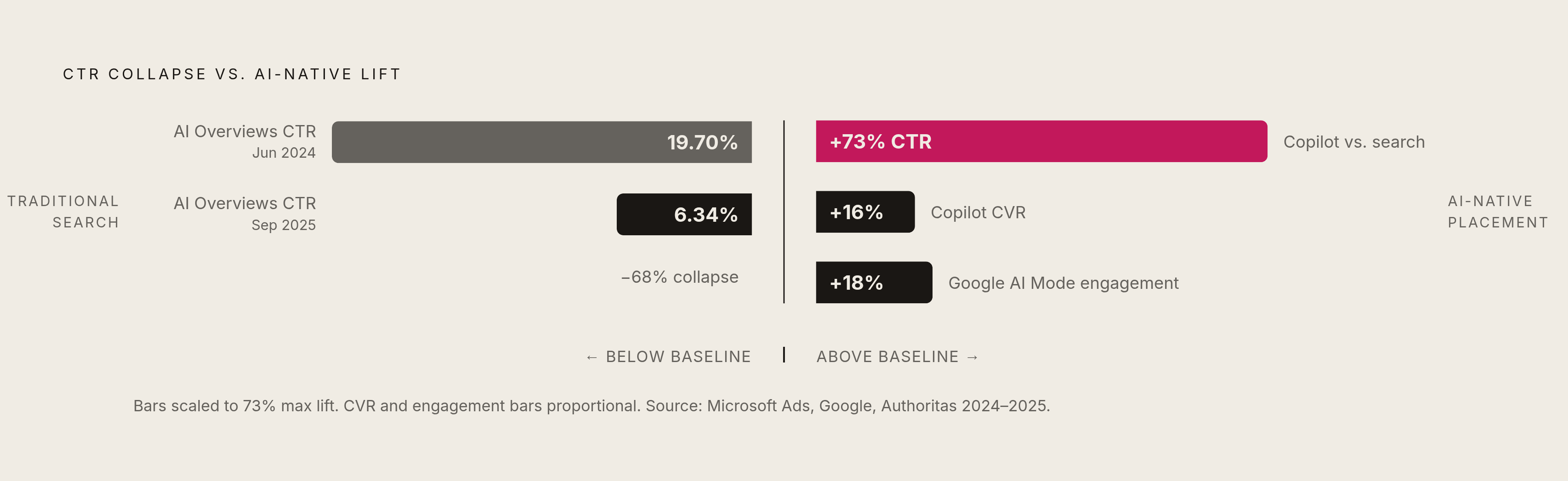
Microsoft's Advertising blog reported in August 2025 that Copilot drove 73% higher click-through rates and 16% stronger conversion rates than traditional search, with customer journeys running 33% shorter. The mechanism isn't mysterious: a user who reaches an ad placement inside Copilot has already refined the question through at least one conversational turn, so the intent behind the click is further along than a cold search query ever gets.
Google's early AI Mode data from May 2026 tells a similar story from a different angle. Ads showed up in 25.5% of AI Mode sessions, with engagement running 18% higher and CPC running 35% higher than traditional search. A higher CPC in ordinary search advertising reads as a cost problem. Inside AI Mode, it reads as audience quality: fewer people reach the ad, but the ones who do have already done more of the thinking.
Set that against what's happening to traditional paid search. Seer Interactive, studying 3,119 terms across 42 client accounts, found paid click-through rate on queries with AI Overviews falling from 19.70% to 6.34% between June 2024 and September 2025. The same AI layer hurting ordinary search ads is the layer benefiting intent-matched placements inside the conversation itself. One exception stands out: when a brand was actually cited inside the AI Overview, its paid CTR ran 91% higher than when it wasn't, which suggests presence inside the AI's own answer, earned or paid, changes performance more than almost anything else measured here.
Zero-click search reached close to 70% of all queries by mid-2025, up from 56% a year earlier, according to Similarweb. Users who never leave the AI interface simply aren't reachable by a traditional search ad. They're only reachable by something living inside the conversation they're already having.
The trust economy inside AI, and why format choice affects more than click rate
Search engines and social feeds run on a trust contract that expects a marketplace of competing links. AI assistants run on a different one: users expect synthesis and a straight answer, not a shelf of options to sort through themselves. Break that contract, whether by tilting the answer toward a sponsor or by cutting into the reasoning a user is following, and the cost lands somewhere harder to recover than a soft click-through number. It lands on confidence in the tool itself.
That's the publisher's dilemma as much as the advertiser's. A chatbot people stop trusting loses exactly the engagement that made it worth advertising on in the first place. Anthropic's refusal to run any ads at all on Claude is the clearest statement of this logic on record: a judgment that any ad format, not just the clumsy ones, would compromise the trust the product depends on. That's the more defensible position, and the platforms running ads anyway are making a bet that disclosure and placement discipline can substitute for the purity Anthropic chose instead. Whether that bet holds is still open.
An assistant that quietly favors sponsors over accuracy degrades its own answer quality, and users notice that faster than they notice most things. Regulators in one major jurisdiction, the EU, Singapore, and Australia have already signaled that algorithmic transparency in AI recommendations is coming, according to ROI·DNA's analysis of emerging AI governance frameworks.
Formats that are clearly labeled, matched to context, and placed after rather than inside the primary answer hold the trust contract together: the user gets the answer asked for, then sees something commercially relevant on top of it. Disclosure, in that structure, is simply part of the format's cost of entry. It's the thing making it durable.
What targeting inside conversational AI actually looks like, and why prompt-level intent changes the buying model
Traditional display targeting works from the outside in: demographic buckets, behavioral cookies, page-level context, all approximations of intent stitched together after the fact. Prompt-level targeting flips that around. The user has already said, in plain language, what the problem or the decision is. Nothing needs to be inferred.
OpenAI's context hints show the gap clearly. An advertiser describing "users comparing project management tools" is matching an intent segment, not bidding on a keyword string the way search advertising has run since the early era of paid search. And because conversations build turn by turn, a user moving from "what is X" to "how does X compare to Y" to "what does X cost" has laid out a purchase path in real time, not just triggered a keyword.
That signal only exists for formats living inside the conversation. A display unit sitting outside or beside the AI's response has no way to read any of it, which is exactly why OpenAI's outcome-optimized bidding weighs conversational context alongside landing page and ad copy. The auction itself is being informed by intent quality, not just impression counts.
That split creates a real gap in who can actually buy this inventory well. Generalist demand-side platforms built for web display have reach across the open internet but no way to read what's happening inside a chat turn. Ad networks built for a single AI surface can read that context but are boxed into one platform's inventory. Neither structure, on its own, is built for what prompt-level targeting actually demands: a buying platform that reads conversational context while still operating across more than one AI surface at once. That's a categorical departure from keyword bidding, not an incremental one, and it needs measurement built for a different signal type.
What remains genuinely unsolved: measurement, attribution, and format maturity
None of this is a solved problem, and pretending otherwise would flatter an industry that's maybe eighteen months into figuring it out. Attribution inside a conversational interface doesn't map cleanly onto the last-click or multi-touch models built for a browsing session. A chat card seen after turn four of a conversation isn't a page view, and the funnel it sits inside doesn't look like a funnel in the traditional sense at all.
Measurement standards across the platforms running ads aren't unified either. OpenAI, and previously Perplexity, built different definitions of engagement, different privacy boundaries, and different bidding mechanics, which means a campaign's performance on one surface doesn't translate cleanly to another. Format maturity is still early too: the chat card and the sponsored follow-up are the first generation of a format type, not the final one. The industry hasn't had enough time to know which variations hold up at scale and which ones quietly erode trust the way display already has.
The direction of travel is clear enough: native, context-matched, clearly labeled placements that respect the turn-based structure of the conversation are outperforming display on every metric currently being reported, across every platform willing to publish numbers. What's not yet clear is how the industry will measure that performance consistently, or hold the line on trust as more advertisers, and more platforms, decide the attention is worth chasing.
Sources
- FAQ on native advertising: Formats, AI opportunities, and the best metrics for 2026
- Native Advertising Guide for Marketers in 2026 | AI Digital
- Can Perplexity's $60 CPM Ads Deliver Real ROI? A Marketer’s Guide to LLM Advertising - SmartyAds
- Advertising in the Age of LLMs: What Happens When AI Becomes the Ad Platform
- Why Native Ads are the Future for LLMs
- rankmehigher.co
- dataslayer.ai