Dayparting and Temporal Pacing in AI Chat Ad Campaigns
Conversational AI lets advertisers target stated user intent instead of relying on the clock.
Dayparting is a bet that when a person is online tells you something useful about what they want. The practice exists to arbitrage attention: put money behind the hours when an audience is awake, engaged, and likely to convert, and pull it back during the hours when they are not. That bet rests on one assumption. The clock stands in for intent, because a timestamp is the best signal an advertiser has when the platform gives up almost nothing else.
On search and social, that substitution holds up reasonably well. A search query is three words. A scroll through a feed offers a glance, maybe a pause, rarely more. With so little to read, the hour of day becomes one of the few variables left that correlates with anything, so marketers lean on it. Meta's own scheduling guidance says as much directly: look at your conversion distribution by hour, put budget where conversions cluster, pull back everywhere else. That advice produces a system that works, but it is built entirely around the clock. Conversion rates swing hard between peak and off-peak hours, so automated bidding follows that swing, because hour of day is the strongest lever an advertiser has.
That architecture made sense for twenty years because nothing better existed. The question this raises is what happens to a clock-based proxy once the platform stops making you guess and simply tells you what the user wants, in their own words, in the middle of the conversation.
What changes when intent is stated rather than inferred
Conversational AI platforms answer that question by removing the need for inference: a user states intent directly. A user's intent inside an LLM conversation isn't pieced together from a timestamp or a handful of keywords. A user states it outright, often in detail, before any ad enters the picture.
Consider the difference in raw material. A search marketer works backward from three words typed into a box. A single ChatGPT session can contain a user's budget, their constraints, the options they're already comparing, and the ones they've already ruled out, all laid out in plain language ahead of any sponsored content appearing. That's a different order of signal entirely, and it changes what the targeting lever actually is.
OpenAI's own framing reinforces how this structure works. The model's response is not for sale: the sponsored unit appears below the answer, clearly labeled and kept separate from what the model actually tells the user. Because the answer itself can't be bought, the only path to performance for an advertiser is relevance to the conversation taking place. There's no shortcut through bid size or time-slot placement that substitutes for actually matching what the user is discussing.
This is the structural break the rest of this piece works through. Once intent is legible directly from the conversation, the next question is what role, if any, remains for scheduling by the clock.
The conversational intent signals that replace the clock as the primary scheduling lever
The unit an advertiser targets in conversational AI is the intent state embedded in the conversation itself, and the advertiser's real job is describing which of those states belong to their product.
Intent appears in layers across a single session. The opening prompt sets the domain. The follow-up turns also expose constraints, stated preferences, and things the user has already rejected. The shape of the conversation over several turns signals where someone sits in a decision process, whether they're still exploring options or close to choosing one. None of that is available from a keyword search, which captures a topic and stops there. A conversation thread can show you the specific objection a user is trying to resolve, the price ceiling they've mentioned, and the alternatives they've already dismissed.
Take a home-services advertiser. They don't need their ad to appear in every ChatGPT conversation about home repair. They need presence specifically in the sessions where someone is asking what a replacement costs or what questions to ask a contractor before hiring one. A B2B SaaS company selling to operations managers faces a parallel problem: the ad needs to show up when the conversation is actually about workflow tooling, not whenever the topic drifts toward general productivity advice.
The advertiser's signal doesn't stop at the context hint that describes these scenarios. Because the auction weighs the hint together with ad copy and landing page content, creative that aligns tightly with the target intent state strengthens the match the auction is scoring. A context hint without matching creative is a weaker bid than the same hint paired with copy that speaks the same language as the conversation it's meant to appear in.
Once intent state carries this much of the targeting load, the obvious follow-up is what, if anything, clock time still contributes.
What Clock-Based Scheduling Still Contributes
Clock time hasn't become worthless. It correlates with which intent states tend to be active at a given hour, even though it no longer determines them the way it once did in search and social.
The post-lunch window, roughly 1 PM to 3 PM, illustrates the pattern. This stretch is marked by a well-documented post-lunch dip in alertness and cognitive performance, which makes it a weak window for conversations that require complex analytical thinking. This stretch's post-lunch dip is a statistical tendency that shapes a starting hypothesis about budget allocation, not a rule that should override what a specific conversation is actually about.
A B2B advertiser might reasonably weight morning and early-afternoon hours more heavily as an initial default, on the theory that work-related conversations cluster there. A consumer advertiser might weight evenings for the same reason. Both should treat these as starting points to test, not schedules to lock in. As campaign data accumulates, time-of-day patterns can inform bid adjustments layered on top of intent-state targeting, once an advertiser can see which hours are actually producing conversions for their specific category.
If clock time correlates with intent state, why not just use the clock as a proxy the way search and social always have? The correlation is loose, and it varies by category, by individual user, and by how a single conversation evolves. Someone can start the evening browsing idly and pivot mid-session into a high-purchase-intent conversation. But a morning work session can stay low-commercial-intent all the way through. Intent state can be read directly from what's being said. Clock time only ever estimates it, and an estimate is a weaker tool than the thing itself when the thing itself is available.
Time-Zone Fragmentation and the Limits of Clock-Based National Campaigns
The weakness of clock-based scheduling becomes concrete the moment a campaign runs nationally. A US dayparting schedule set purely by the clock doesn't reach one audience in one state of mind. It reaches audiences in four separate time zones, each in a different cognitive moment at the exact same instant the schedule fires.
Picture a campaign set to run from 7 AM to 9 AM Eastern without any time-zone segmentation. At that moment, Eastern users are in morning-planning mode, already well into their day. Central users are still in the early pre-work hours. Mountain users are barely awake. Pacific users are, for the most part, still asleep. A single flat schedule is treating four distinct conversational moments as though they were one, and only one of the four groups is actually in the state the schedule was built around.
The conventional fix has been staggered budget allocation: treat each time zone as its own rolling priority window rather than running one national daypart, shifting spend from the East Coast morning window into Central, then into Pacific, as the morning moves west. It works, but it's operationally heavy, and it demands a level of campaign segmentation that most advertisers never build, especially when they're just getting started on a new platform.
Intent-state targeting sidesteps the problem instead of solving it with more scheduling complexity. A context hint describing a specific conversational scenario fires whenever that conversation occurs, regardless of what time zone the user sits in or what their local clock reads. A Pacific Coast user having a high-intent planning conversation at 6 AM local time matches that context hint just as cleanly as an Eastern user having the identical conversation at 9 AM. The targeting was never anchored to a clock, so staggering spend across time zones is unnecessary.
This doesn't make time-zone segmentation obsolete everywhere. If a category has strong regional behavioral patterns, like local services or location-dependent offers, you still benefit from building it in. But as a national default, intent-state targeting scales in a way that clock-based time-slot targeting structurally cannot.
Budget Pacing and Conversational Spikes
Even an advertiser who sets exactly the right dayparting windows runs into a second problem: conversational demand doesn't move on a schedule. It moves with topic and cultural moment. Demand spikes can land anywhere on the clock, and a fixed schedule has no way to anticipate where.
Practitioners who analyze trending-topic conversation surges have found campaigns burning through as much as 40% of a daily budget in a two-hour window, because the spend follows conversational demand, not any pre-set schedule. ChatGPT Ads gives some relief here: automatic daily budget pacing and weekly-average daily budgets cap spend at a multiple of the daily budget on any single day and a larger multiple across a seven-day period. That gives some room to absorb a spike, but it's platform-level smoothing. It isn't the same as advertiser-controlled pacing built around intent.
An advertiser locked into a fixed morning daypart can miss an afternoon or evening surge in precisely the high-intent conversations their context hint was built to match. The schedule excludes spend the advertiser should actually be making. The more durable response is to set intent-state targeting precisely enough that the platform's own pacing mechanism can move budget toward the windows where relevant conversations are actually happening, rather than pre-committing to clock slots that may have no relationship to when those conversations spike.
Fixed schedules still make sense when you can genuinely predict conversational demand, as with B2B tools during standard business hours. They carry more risk for categories where demand is event-driven or seasonal: tax season, a product launch, a news cycle that suddenly pulls a category into relevance. In those moments, intent state concentrates sharply and clock time tells an advertiser very little about when the relevant conversations are actually taking place.
If fixed schedules can't be trusted in categories like these, the next question is how an advertiser builds enough data to know what to trust instead.
Building the data feedback loop when no historical benchmarks exist
The platform's own history limits what any advertiser can lean on today. ChatGPT Ads moved from a closed pilot, announced in February 2026, to self-serve public availability in May 2026, so every advertiser running campaigns now has to work without any inherited optimization data. Any rule circulating about the platform is a hypothesis someone is testing.
Meta's own scheduling guidance has always demanded this same discipline, but here it applies to a platform where the historical conversion distribution simply doesn't exist yet, not yet. Meta tells you to analyze your own conversion data before you set a schedule. On ChatGPT Ads, there's no inherited distribution to analyze, so that analysis has to start from zero, with each advertiser generating the data themselves.
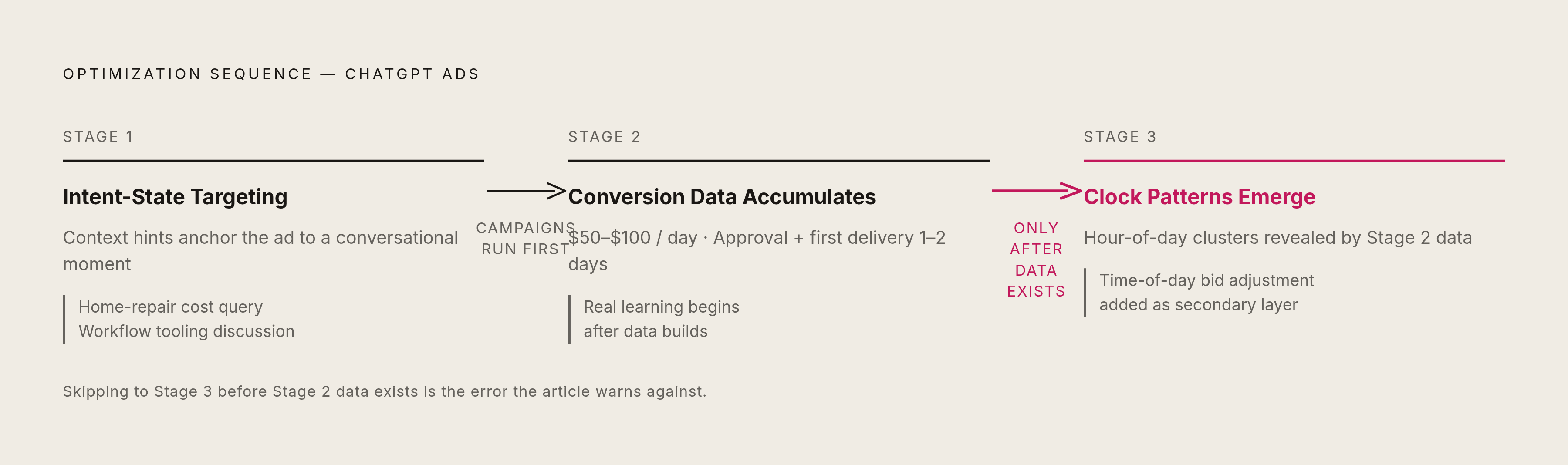
Practitioners suggest you start with a daily budget big enough to generate a usable signal, roughly $50 to $100 a day in early accounts, rather than a minimal test budget that produces too few conversions to draw any conclusion from. First-campaign approval and initial ad delivery typically take a day or two as well, so the real learning period starts later than the campaign's official launch date.
During that learning phase, the thing to track is which conversational contexts the platform reports as producing conversions, and whether those contexts cluster at particular hours. That clustering, once it appears, is how clock-time patterns become visible again, not as the primary lever but as a secondary layer sitting on top of intent-state data that's already been collected. The sequence runs in one direction: intent-state targeting generates conversion data first, that data reveals whether clock-time patterns actually exist for a given category, and those patterns then inform bid adjustments layered onto intent-state targeting.
Advertisers used to Google and Meta are used to platforms that hand over optimization signals fast, and the temptation to import a legacy dayparting schedule onto ChatGPT Ads runs high precisely because the native data takes longer to accumulate. That temptation is worth resisting. A schedule built on search-and-social habits is a schedule built on a clock serving as a stand-in for intent, in a platform where intent no longer needs a stand-in. The data an advertiser builds here, patiently and without shortcuts, is what eventually lets the clock earn back a legitimate, secondary role in the schedule.