Zero-Click Conversions and Publisher Revenue Loss in AI Search
AI Overviews eliminate publisher visits entirely, collapsing the search-to-revenue chain.
For two decades, the open web's economic model fit into a single, legible chain: search volume produced clicks, clicks produced pageviews, and pageviews produced ad impressions and affiliate revenue. Generative AI has broken that chain at its first link. The break is structural, not cyclical, and it will not repair itself.
The mechanism is precise. AI Overviews and chat interfaces resolve user intent on the results page itself. The visit to the publisher, the event that triggered every downstream revenue action, simply does not happen. Past search algorithm updates reshuffled which publishers got clicks. This change reduces the total pool of clicks available to all publishers simultaneously. That distinction matters because it changes what the problem is. A reshuffle rewards adaptation. A shrinking pool demands a different kind of response entirely.
The scale of the collapse in publisher search referrals
The traffic declines are large enough, and consistent enough across outlet sizes and types, to confirm that the break is systemic. This is not a handful of poorly positioned sites feeling the effect of an algorithm change. It is a broad, simultaneous contraction across the publishing landscape.
The named cases establish the pattern. By July 2025 Forbes had lost roughly half of its traffic year-over-year. HuffPost was down 40 to 42 percent over the same period. These are major, established properties with substantial search equity and mature content operations, not marginal players who depend on a single traffic trick. The consistency of the declines across different outlet types and audiences makes the systemic nature of the break difficult to dispute.
The hardest evidence comes from financial disclosure rather than traffic estimation. IAC's 10-Q filing shows search revenue at Ask Media Group decreased $53.2 million, or 76 percent, to $17.1 million, with Ask Media Group alone down $46.4 million, an 80 percent decline. The company attributed the drop primarily to Google algorithm changes and AI Overviews reducing visitors to ad-supported content sites. This is a reported financial figure in a regulatory filing, not an extrapolation from third-party measurement panels. When a public company quantifies the damage in a quarterly report, the structural nature of the change moves from analytical claim to accounting fact.
Why the revenue loss is worse than the traffic loss alone suggests
Lost traffic is only the first hit. The revenue damage cascades through every monetization mechanism that depended on that traffic, so the financial contraction compounds instead of tracking the traffic decline in a straight line. The cascade mechanics follow logically from how open-web advertising works. Fewer pageviews produce fewer ad impressions, and CPM compression follows as the supply of impressions shrinks while demand from brand-safe open-web inventory also softens. Video ad inventory shrinks as fewer users load video-heavy pages, and video is a format that typically commands the highest CPMs. AI responses rarely include affiliate links, so even publishers that still get some organic visits see affiliate revenue drop. These are not separately sourced figures. They are the direct consequences of a traffic collapse for a business model built on impression volume.
The paywall problem is a structural variant of the same failure. Paywalled publishers need users to reach their site before they see a subscription prompt. If the AI answers the question, the user never hits the paywall and never converts to a subscriber. The subscription model assumes a visit. The zero-click era eliminates the visit.
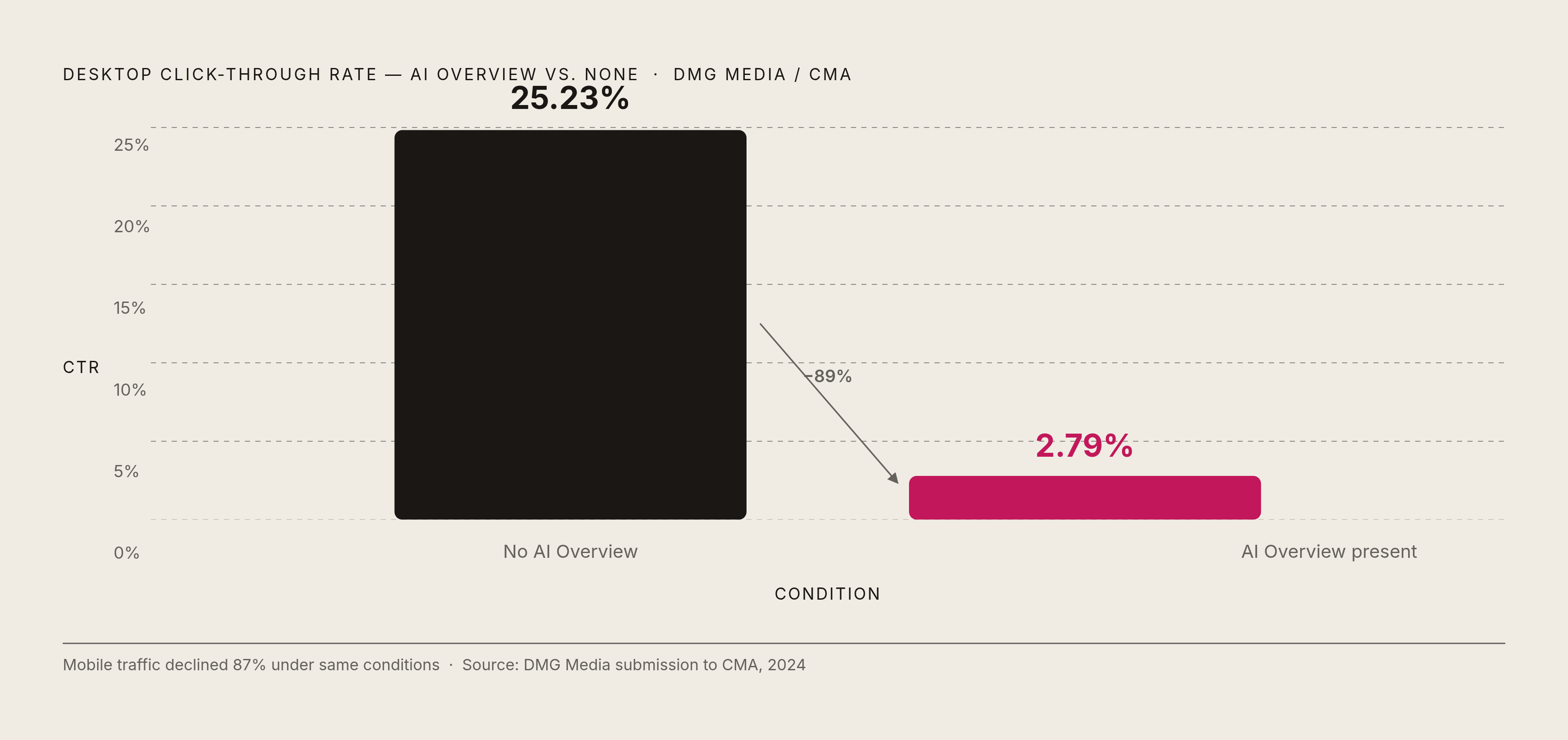
Two hard data points anchor the section. Google Network ad revenue, the most direct measure of what AI Overviews are doing to the open-web ad economy, fell year-over-year in Alphabet's Q1 2026 earnings to $6.97 billion. That is a concrete signal that compression is reaching the revenue layer, not just the traffic layer. DMG Media's disclosure to the UK Competition and Markets Authority is more granular. It shows the click-through rate on desktop falling from 25.23 percent to 2.79 percent when an AI Overview surfaced above a visible link, an 89 percent reduction, with mobile traffic declining by 87 percent. This is not a percentage of lost impressions. It is a near-elimination of the click event itself, the action on which the entire monetization chain depended.
AI platform referrals are real but nowhere near sufficient to replace what search provided
AI platforms do send referral traffic to publishers, and that traffic is growing. The problem is that the base is so small that even rapid growth leaves publishers deeply underwater relative to what they are losing from search. The referral quality argument is real but limited. Visitors who arrive from AI platforms tend to be further along in a decision and bounce less often. But a small number of higher-quality visits does not offset a large collapse in total visit volume when revenue is tied to impression counts. A publisher compensated per thousand impressions cannot make up a fifty percent traffic decline with a modest improvement in engagement metrics.
The Perplexity episode illustrates how fragile the AI referral model has proven to be. Perplexity's publisher program initially offered revenue shares when content appeared alongside ads, and it drew more than 300 publishers. Then, in February 2026, Perplexity abandoned advertising entirely and moved to a subscription-only model, stranding the publishers who had bet on that income stream. Perplexity's ARR accelerated after February 2026 because of the launch of its Computer agentic tool and usage-based pricing, not because it left advertising. The platform optimized for its own economics, not the publisher's. The lesson is not that Perplexity acted in bad faith. It is that publishers cannot build a stable revenue model on the strategic choices of an AI platform that has no structural reason to prioritize their interests.
What the zero-click era reveals about where purchase intent has moved
The AI chat interface that displaced the publisher visit is not a void. It is a place where users state their intent, constraints, budget, and decision criteria in plain language. When you type a product query into a chat window, you hand over purchase intent, price sensitivity, use case, and timeline in a single sentence. That is more information than any search keyword has ever contained, and it arrives without requiring cross-site tracking. The zero-click era has therefore produced something paradoxical: the highest-signal commercial environment that has ever existed at scale, one that happens to sit outside the publisher's site.
This reframes the problem for publishers and advertisers. The question is no longer how to get users back to the publisher's page. It is how to be present, and commercially relevant, inside the AI conversation where the decision is actually being made. The zero-click shift is not simply a loss. It is a relocation of purchase intent to a new surface, and the commercial opportunity follows the intent.
How advertising inside AI conversations works as a monetization model
Conversational AI advertising is a distinct category. It consists of paid, targeted commercial messages matched to the intent of the conversation in progress. It is not search ads reframed with an AI summary alongside them, not chatbots that sell things, and not AI-generated ad creative. The mechanics differ from search at every meaningful layer.
There is no keyword layer. Targeting looks at natural-language context, the full conversational trajectory, not a single query. Intent is stated rather than inferred from a fragmented three-word search string. That changes what the advertiser is buying. A search ad responds to a query. A conversational ad responds to a need you stated within an ongoing exchange.
The infrastructure is operational, not theoretical. Criteo became the first ad tech partner to integrate with OpenAI's advertising pilot inside ChatGPT Free and ChatGPT Go in the United States, announced March 2, 2026. Third-party buying against conversational inventory is no longer a proposal. It is a functioning channel.
Attribution remains unsolved. You may ask several follow-up questions, leave the chat, and convert later, so last-click models structurally undercount the channel. Honest deployment of conversational AI advertising requires acknowledging this gap and investing in measurement models that account for the conversation's role in the path. The absence of clean attribution does not make the channel unviable. It makes the measurement question part of the work.
The structural advantage for publishers is significant. An AI surface that can sell contextually matched advertising against its own conversation inventory has a monetization mechanism that does not require the user to click through to an external site. It earns revenue from the conversation itself. That is the first open-web monetization mechanism in two decades that does not depend on a visit.
Which publisher categories face the steepest path and which have structural advantages in the transition
The zero-click impact falls unevenly by content type and vertical, and the same unevenness shapes which publishers can most plausibly monetize through conversational AI advertising rather than waiting for search referrals to recover. This is not a winners-and-losers ranking. It is a map of where urgency is highest and where the conversational advertising opportunity is most commercially legible.
Travel depends on search more than any other major vertical in absolute spend terms. If consumers use AI before visiting a travel site, they arrive further along in their decision, and their bounce rates are measurably lower. That is both a threat and an argument. It is a threat because fewer visits occur. It is an argument for advertising at the point of AI interaction rather than trying to recapture the visit afterward. Trip.com's TripGenie illustrates the alternative. The tool turns natural-language requests into itineraries and bookings. Users who plan with TripGenie are 30 to 40 percent more likely to return to the platform, with twice the order conversion rate of other users. Trip.com built conversational commerce rather than waiting for search referrals to return.
Health and finance carry the highest brand suitability exposure in LLM environments for publishers selling inventory and for advertisers buying it. These verticals require more rigorous contextual matching and safety infrastructure, not less. The burden is heavier, and it falls on categories where being present in an AI answer carries regulatory and reputational stakes that a travel recommendation does not.
The HubSpot case is instructive. A publisher-adjacent brand that built its acquisition model heavily on organic search traffic saw that model collapse, then pivoted to optimizing for AI citations. The shift was directional: toward being present in AI interfaces rather than fighting to restore click traffic. It signals the broader reorientation that the zero-click era demands.
What publishers who survive the zero-click era will have in common
To survive the zero-click era, you have to abandon the assumption that monetization follows from traffic. What takes its place is a set of models where the AI interface itself is the commercial surface: direct conversational advertising inventory, AI citation optimization that keeps brands present in AI responses, or conversational commerce that closes transactions inside the interface. Three orientations distinguish publishers likely to adapt from those likely to contract further. The first is treating the AI conversation as a distribution surface rather than a threat to distribution: building or supplying inventory inside AI interfaces rather than only optimizing to be cited in them. The second is shifting from impression-volume economics to intent-quality economics. Fewer, higher-intent interactions can generate more commercial value than large volumes of low-engagement pageviews, but only if the monetization mechanism is designed to capture that value at the point of conversation. The third is investing in contextual ad infrastructure designed for conversational environments, not retrofitted from display or search, that can match commercial messages to the substance of a conversation rather than to a page URL or a keyword bid.
The platform layer that makes this possible is still forming. The Criteo-OpenAI integration and the Microsoft Copilot ad model are early infrastructure, not mature markets. Publishers that engage with conversational AI advertising now do so while the pricing, format, and attribution standards are still being set. That is both the risk and the competitive advantage of early entry. The standards will be written by the participants who show up first.
The broader principle closes the argument. The two decades of open-web economics were themselves a specific historical window, search-driven discovery married to display advertising, and that window is closing. Publishers who survive will be those who recognize that the next window is the AI conversation, and who build the commercial infrastructure to operate inside it rather than waiting for clicks to return. The equation that broke was never a law of the web. It was a configuration of technology and attention, and configurations change.