View-Through and Assisted Conversion Tracking in LLM Environments
Conversational AI breaks traditional click-based attribution models.

Conversational AI advertising has an attribution problem, and it is unlike anything search or social produced. The interface that shapes a buying decision is no longer the interface that records the click, and that single break forces a rethink of how marketers measure influence.
Why multi-turn AI conversations break every attribution model built for the web
Legacy digital advertising was built around three discrete, trackable events: the ad, the click, and the destination. An advertiser could place a pixel, drop a cookie, or run a tracking script at each handoff, because each handoff happened on a surface the advertiser partially controlled. A banner impression led to a click, the click led to a landing page, and the landing page logged a conversion. Every link in that chain produced a record.
A conversational AI interface collapses that chain into something harder to see. The attribution system captures only the eventual click, and often not even that. If the user never clicks, you get no record, even though the conversation did the work a landing page used to do.
The asynchronous nature of these conversations makes the gap wider. If you keep chat history turned on, a standard ChatGPT conversation stays there indefinitely. Connecting those two moments, the first exposure and the eventual action, requires attribution infrastructure that most organizations simply have not built yet.
Better UTM hygiene will not close this gap. The problem sits upstream of the link, in a conversational layer that most measurement stacks were never built to observe.
Assumptions Conversational AI Violates in Last-Touch and Multi-Touch Models
Last-touch and multi-touch models both depend on a set of assumptions: that events are discrete, that clicks are observable, and that sessions have clear boundaries.
Last-touch attribution assumes the last recorded click caused the conversion. In a conversational environment, the decision often forms across several turns, and these happen before any click occurs. By the time a click is logged, the real moment of persuasion may already be well in the past, so the model ends up crediting the wrong touchpoint, or crediting a completely different channel for work the conversation already did.
Multi-touch models assume you can observe and count every touchpoint on its own. A model cannot count what it never sees, so it undercounts the influence by design, not by accident.
Both model types also assume clean session boundaries, but you do not get that with conversational AI. The mismatch means a "session" in the reporting sense has little relationship to a conversation in the user's own sense of the experience.
The result is active misattribution. When a conversational ad genuinely influences a conversion, that credit goes instead to whatever channel the user visited last, usually direct traffic or branded search, after the chat window was already closed. Assisted conversions, brand mention tracking, and holdout testing are where organizations that recognize this problem tend to start, and resolving the attribution architecture before spending further is the first move, not a cleanup task for later.
How the conversation itself generates attribution signals, even without a click
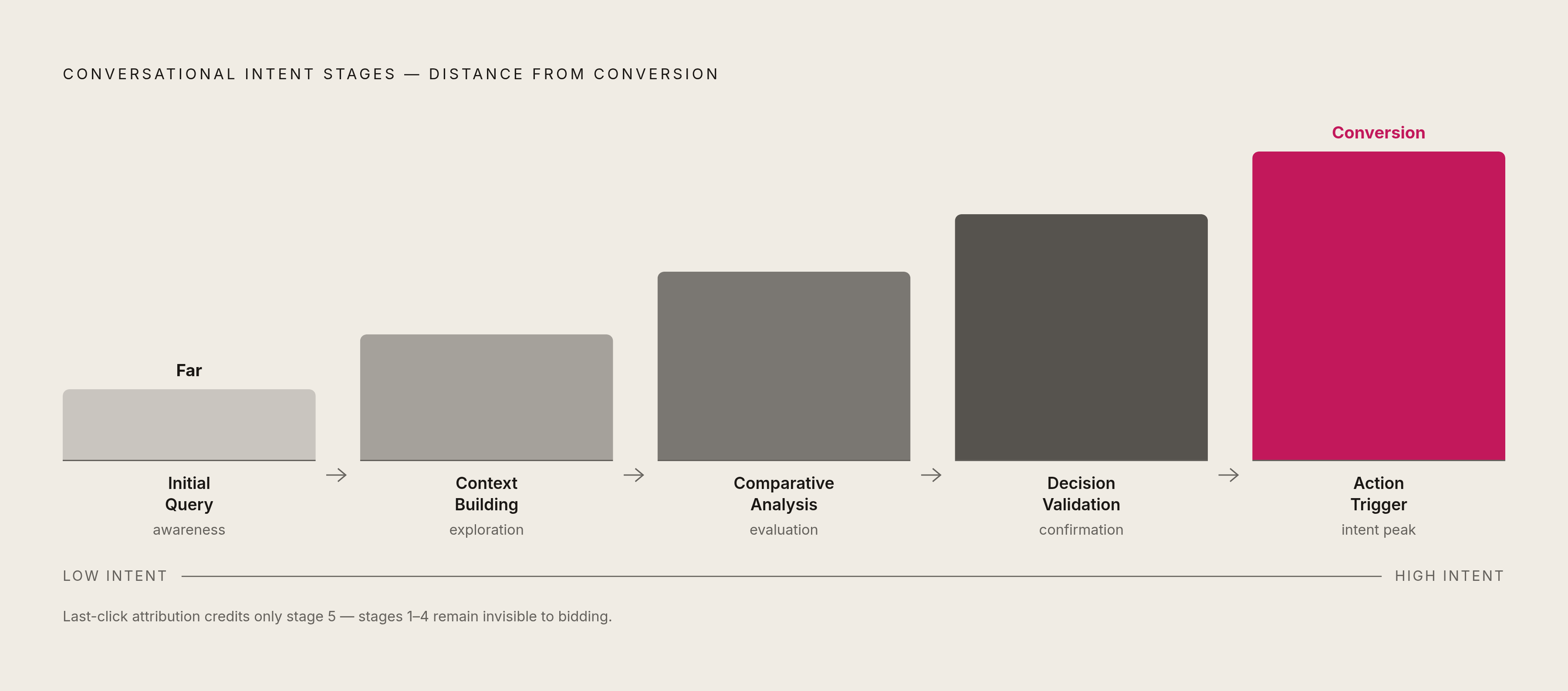
Multi-turn conversations are not black boxes. They generate intent signals richer than anything a keyword search ever produced, but those signals live inside the conversation itself, not in a URL parameter, so you need different instrumentation than a search campaign ever needed.
A search query is typically two or three words that an advertiser has to reconstruct into inferred intent. Intent arrives declared, in plain language, instead of something you have to infer from a handful of keywords.
The conversation moves through recognizable stages, and each one carries a different intent intensity. Five stand out: Initial Query, Context Building, Comparative Analysis, Decision Validation, and Action Trigger. Bid strategy and attribution credit need to treat those two moments differently, because they are at very different distances from a conversion.
The practical limit on reading these signals comes from the platform itself. OpenAI's advertising reporting gives advertisers high-level metrics: impressions, clicks, views, spend, CTR, average CPC, average CPM, and conversions. Advertisers do not get access to user memories or chat history, so the richest part of the signal, the actual language of the conversation, stays out of reach. What can be measured has to be proxied at the click boundary or inferred through aggregate methods built for exactly this kind of visibility gap.
First-party data architecture as the foundation for conversational attribution
The only attribution layer an advertiser fully controls is on the destination side of the click, in the systems the advertiser owns. If you buy conversational AI inventory before building that layer, you cannot go back and revisit it later. It is the prerequisite that makes every other method in this piece possible.
Every URL used for conversational AI traffic needs to carry enough parameter data to reconstruct what happened in the conversation, because the AI interface will not pass that context along on its own. None of that detail survives the handoff unless the link carries it.
Once a user lands, the full parameter string needs to be captured and stored immediately, in a first-party cookie or in local storage, and then pushed into the CRM as custom fields on the contact record. That step matters because leads from conversational AI rarely convert on first visit. If you preserve the conversational context at the moment of landing, that context is still there days or weeks later when the lead actually moves through the funnel.
One more piece of this foundation gets less attention than it deserves: a simple "How did you hear about us?" field that lets a lead name ChatGPT or AI Search directly. Self-reported attribution captures the channel at the exact moment someone's recall of it is strongest, without needing cross-device identity resolution. It is a low-cost source of truth that sits alongside the more technical layers without replacing them.
View-Through Credit in Conversational Environments
View-through attribution is the right starting framework for this channel because it was built for exactly this situation: influence that happens before a click, or without one ever occurring. Applying it to conversational AI means adjusting the window, the weighting, and the boundary conditions that display and video advertising originally set it up to handle.
View-through credit assigns partial or full value to an impression that a user saw but did not click, on the premise that the exposure shaped a conversion that arrived through a different path later on. In a conversational AI interface, sponsored mentions appear in visually distinct placements inside a response, and if a user just keeps talking instead of clicking, nearly every meaningful exposure fits the definition of a view-through event. That reframes the core measurement question from "did they click" to "were they exposed."
The window itself needs rethinking. Conversational AI does not follow that rhythm. A user can bookmark a ChatGPT conversation and return to it days later to pick up exactly where the research left off. The gap between first exposure and eventual conversion runs longer and more unevenly than any legacy display default was built to anticipate.
The broader industry is already moving in this direction. At Google Marketing Live 2026, Google announced VTC Optimization, aimed at driving more conversions by optimizing specifically for view-through conversions inside Demand Gen campaigns, alongside Campaign Type Attribution, a separate measurement solution built to isolate Demand Gen's conversion performance from other channels. That two-part announcement signals that the largest measurement infrastructure in the industry is building toward the same problem conversational AI now presents.
View-through credit carries a real risk of over-attribution. Calibrate the window conservatively and check the results against a separate validation layer: lift testing.
Holdout testing and conversion lift studies as the validation layer
Conversion lift studies answer the question view-through credit cannot answer on its own: whether conversational AI ads are creating conversions that would not have happened otherwise, rather than simply getting credit for demand that already existed. The method is exposing a test group to the ads, holding a matched control group back from that exposure, and measuring the difference in conversion rates between the two.
This approach works well for conversational AI because you do not need individual-level identity resolution across devices. The signal being measured is the gap between two groups, not the path any single user took to get there.
Defining "exposure" cleanly is harder in a conversational AI setting, because users in the same demographic pool may run into AI interfaces organically, with no paid activity involved at all, which makes the line between exposed and unexposed less tidy than it is in a traditional media buy.
A well-designed pilot names the outcome it is measuring before the campaign goes live, whether that is a qualified inquiry, a purchase, or a booked meeting, and it compares that outcome against an established channel baseline rather than against the platform's own self-reported numbers. That comparison is what tells a marketing team whether a conversational placement is creating new demand or simply relocating where an existing interaction gets recorded. Running the test is how you tell genuine lift apart from attribution shuffling.
Marketing Mix Modeling for delayed and cross-device conversational influence
Marketing Mix Modeling reaches the part of conversational AI's influence that neither view-through windows nor lift studies can touch: conversions delayed by weeks, journeys that cross devices, and the compounding effect of several AI conversations happening over time.
MMM works at the aggregate level: it detects statistical relationships between advertising activity in one period and revenue changes in a later one.
The specific value MMM adds here is its ability to catch delayed effects that no other method in this piece can see. If a user is influenced by a ChatGPT conversation in one month but converts weeks later through an entirely different channel, no method built around tracking individual users can see them. You can detect that same effect statistically in an MMM that includes conversational AI spend as its own input variable, because the model measures the relationship between spend and revenue across the full period, not one person's path.
That last condition matters enormously. Conversational AI spend has to enter the model as a distinct input variable rather than getting folded into a general "digital" or "paid media" bucket. Blend it into a broader category, and the model loses the ability to isolate what that spend specifically contributed.
MMM carries the same limitation here that it carries in every other channel: it needs enough spend history and conversion volume behind it to produce a reliable signal. That makes it far more useful for validating a conversational AI program that has been running for a while than for evaluating a first test launched a month ago. It belongs at the end of the measurement stack, confirming what the earlier layers suggest.
What assisted conversion reporting needs to show for conversational AI to be trusted internally
Every framework described so far can be built correctly and still fail to win budget, if the reporting built on top of it cannot show finance and channel owners the assisted contribution in terms they already trust. The assisted conversion report is as much a communication problem as it is a technical one.
You should also watch a secondary signal alongside it: a spike in direct traffic that lines up with conversational AI campaign activity. Some of conversational AI's influence appears as direct traffic: users close the chat window and type the brand name straight into their browser. Cross-referencing those spikes against campaign dates is a low-cost way to corroborate influence that the primary attribution model might otherwise miss.
Conversational AI deserves that same framing, but at a higher intent level, because its influence happens while people are actively researching, not passively scrolling.
Why the intent quality of conversational traffic changes what an assisted conversion is worth
The business case for building this attribution infrastructure is stronger for conversational AI than it is for display or social, because the user arriving through AI influence is further along the decision path at the moment of first click.
The mechanism behind that gap is structural rather than coincidental. LLM users tend to prompt with detailed context already loaded in: budget, constraints, a shortlist already narrowed down. By the time that user reaches a brand's site, the AI has effectively already run the comparative analysis and done the shortlisting, so the person arriving is verifying a decision.
It actively misallocates budget away from the channel doing the work and toward channels that are simply recording the output of someone else's influence.
The Measurement-Ready Conversational AI Program
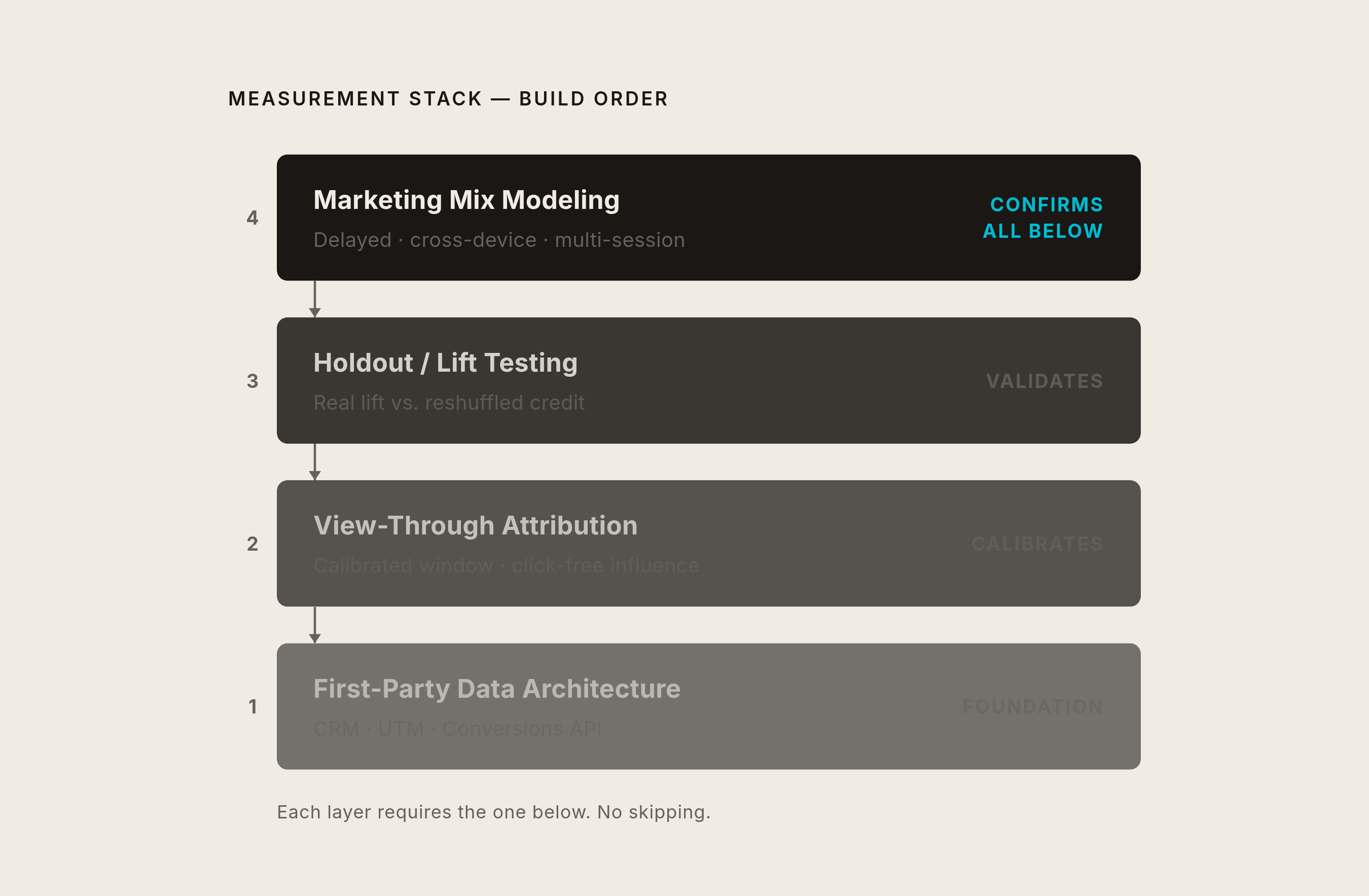
Organizations that treat attribution as a problem to fix after launch will consistently undercount what conversational AI is actually doing, and they will cut campaigns that are working because the reporting never showed the work. The measurement stack needs to exist before the first impression goes out, because conversational context cannot be reconstructed after the fact once it is gone.
Before launch, a few things need to already be in place: CRM custom fields built to hold conversational context parameters, a Conversions API connected and tested end to end, AI-referred traffic segmented as its own reporting dimension, and self-reported attribution fields live on the pages where conversions actually happen.
None of the frameworks described here are exotic. View-through attribution with a calibrated window, lift testing, Marketing Mix Modeling, and first-party data architecture all exist already and are in active use across the industry. The gap holding most organizations back is organizational: the methods exist, but most teams have not yet connected them into a single coherent stack built for a channel where the influence happens before the click, by design.