Ad Ops Vendor Taxonomy for the Emerging In-Conversation Native Advertising Stack
Marketers need five distinct functional layers to buy ads inside AI conversations effectively.

Conversational AI advertising platforms let brands buy paid placements inside AI conversations and answers. As of October 2026, the buyable surfaces are ChatGPT, Google AI Mode and AI Overviews, and Microsoft Copilot. Evaluating this emerging stack requires five distinct layers, because buying access alone does not provide targeting, suitable creative, landing-page relevance, or reliable measurement.
Why the existing ad ops toolkit does not map onto in-conversation native placements
Legacy digital advertising assumes a page or feed, a keyword, a cookie, and a click as the foundations of delivery and attribution. An AI assistant instead presents a conversation delivered one turn at a time. The conversation becomes the placement unit. Its topic, intent stage, specificity, and depth shape eligibility, so targeting cannot be separated cleanly from the answer the user is reading.
On ChatGPT, the primary targeting control is a natural-language context hint matched against the live conversation. At the other end of the stack, last-click attribution cannot account for influence without an attributable click. A toolkit built to manage keywords and attribute clicked visits needs more than another channel label to work as a conversational advertising stack.
How to think about the stack as distinct functional layers before naming any tools
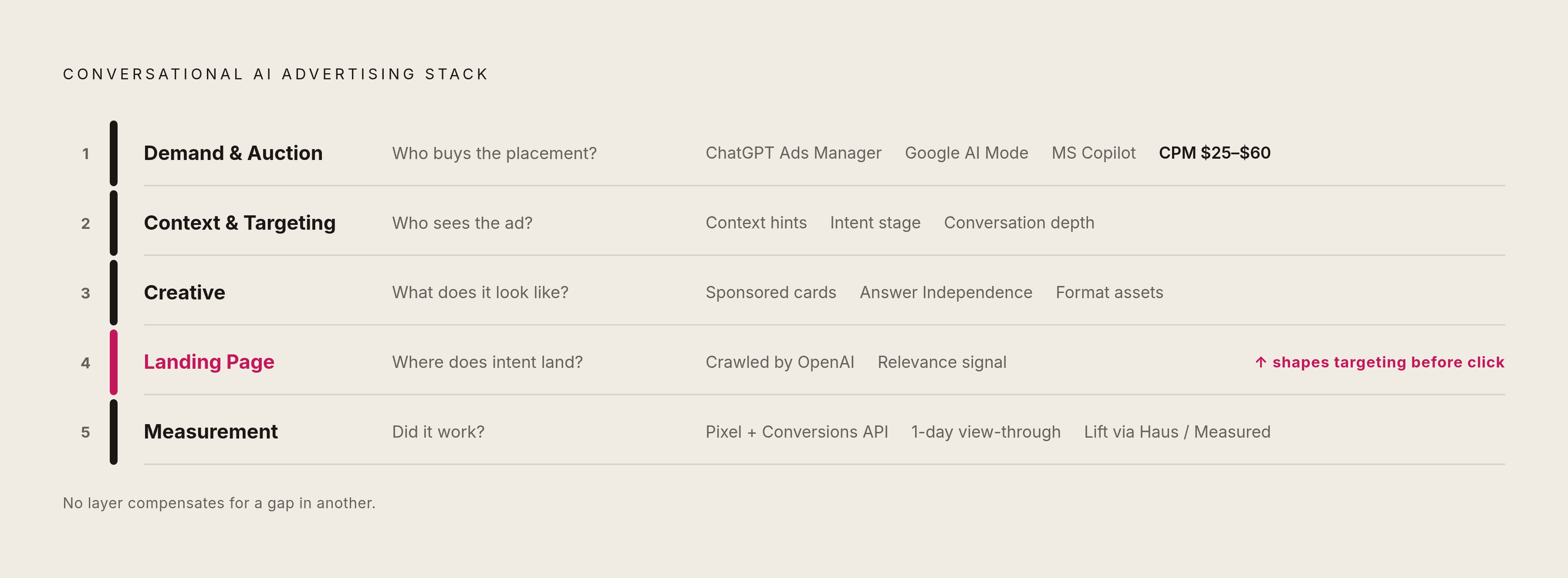
A layer is a distinct function that the stack must perform, regardless of which platform or vendor supplies it. The five functions are demand and auction, context and targeting, creative, landing-page signal, and measurement. Each answers a different operational question. They establish where an ad can run, which conversation makes it eligible, what the user sees, whether the destination matches that intent, and how results inform bidding.
These functions connect, but they are not interchangeable. A creative generator cannot repair a targeting gap, and an attribution partner cannot make an irrelevant landing page relevant to the auction. The landing page deserves its own layer because OpenAI reads it as a relevance signal, not merely as a destination. This taxonomy applies across all three buyable surfaces, while the native controls and tooling available at each layer differ.
Layer one: the demand and auction layer, and what buying in a conversational environment actually means
The demand and auction layer establishes inventory access, buying terms, and the interface through which campaigns operate. As of October 2026, ChatGPT offers its Ads Manager, while Google AI Mode and AI Overviews draw on eligible Google campaigns and Microsoft Copilot draws on eligible Microsoft campaigns. Access does not mean a guaranteed placement. Google and Microsoft automatically include eligible campaign and ad types, without an advertiser opt-out, and assemble ads from assets already in the account.
OpenAI’s September 16, 2026 announcement introduced an Ads Manager plugin that lets advertisers create, update, and analyze campaigns directly in ChatGPT through natural-language prompts. Its auction is relevance-weighted and second-price, with reported ChatGPT Ads CPMs of $25 to $60. A more relevant ad can beat a higher-bidding competitor. Budget therefore cannot be evaluated independently of the targeting and destination signals that determine relevance.
Perplexity ended advertising in February 2026, while Claude, the Gemini app, and Meta AI sell no placements. Those surfaces belong in an organic plan. In particular, buying Google AI Mode and AI Overviews is not buying the Gemini app, despite the shared association with Google’s AI products.
Fragmented buying interfaces create a role for a demand-side platform that buys across AI surfaces while retaining native controls. It sits between generalist buying platforms that lack conversational context and AI ad networks that buy on a single surface and lack cross-surface reach. The evaluation criterion is therefore whether the buying layer connects relevant inventory across surfaces.
Layer two: context and targeting, where conversational intent signals replace keywords
The context and targeting layer converts a conversation into an eligibility decision. On ChatGPT, the main input is the context hint, a freeform description written at the ad group level of the conversations where an ad belongs. The context hint must describe a user’s problem well enough to match the live exchange, which may contain a budget, constraints, a shortlist, and options already rejected.
ChatGPT evaluates topic category, intent stage, query specificity, conversation depth, and user tier before determining eligibility. Intent may be research, comparison, or decision. Custom audiences, location, and platform-level settings supplement context hints.
Other surfaces expose different controls for the same function. Microsoft Copilot triggers ads from the whole conversation within a session. Microsoft calls its separate transitional summary “ad voice,” which acknowledges the organic response and introduces the advertiser’s message naturally. Google’s targeting runs through AI Max for Search, AI Max for Shopping, and Performance Max, where feed and asset quality are the inputs.
For ad ops teams, the corresponding workflow is an intent category map. It should cover the problems the product solves, framed as what a user is trying to figure out. This map gives targeting work a concrete output. It also supplies the context that creative and landing-page teams need, without treating one platform’s targeting control as universal.
Layer three: creative, where the format constraint of the tinted box changes what good looks like
ChatGPT ads appear as labeled sponsored cards in visually distinct “tinted boxes” below the AI’s actual answer. OpenAI’s “Answer Independence” principle separates that sponsored content from the answer itself. The format makes the creative brief specific. The user has just asked a question and is reading a response, so the ad must match that problem-solving context rather than behave like a display banner broadcasting a brand message.
Each intent category and conversation context needs its own creative angle and visuals. That separation lets a test reveal which buyer need converts. Context specificity governs what good creative looks like. An ad aimed at multiple needs at once is poorly matched to an auction that evaluates relevance to a particular conversation.
Native AI drafting tools and third-party AI ad generators help make the creative at this layer. Their role does not remove the need for a context-specific brief. As of September 16, 2026, ChatGPT Ads Manager was testing copy and imagery suggestions based on the landing page and campaign objective, with broader availability expected in coming weeks. Google AI Mode formats use Gemini to build creative per query, making the source assets part of the production process.
Format selection therefore precedes production. Google Marketing Live 2026 included Conversational Discovery Ads, Highlighted Answers, AI-Powered Shopping Ads, and Business Agent for Leads, each with different creative requirements. A team should specify which format the assets serve rather than treat “AI ad creative” as a single deliverable. Tool evaluation at this layer follows that requirement.
Layer four: the landing page as a targeting input, not a post-click afterthought
OpenAI reads the landing page as a relevance signal and crawls it during review. The destination therefore participates in targeting before a user clicks. This changes its operational role. A page that pivots away from the conversation that triggered the ad creates a relevance discontinuity, weakening both the user experience and the auction’s assessment of fit.
Every ad angle and audience segment therefore needs a landing page that matches it instead of one generic campaign page meant to serve all audiences equally. OpenAI’s September 16, 2026 announcement named Shopify as its first ecommerce partner and HubSpot as its first CRM partner, connecting this layer to commerce and CRM infrastructure. Ad ops therefore needs coordination with those system owners alongside a handoff to a page-production team.
The destination itself is also beginning to change. Sponsored Agents, testing with select US advertisers, shift the continuation from a conventional page to a business agent the user can keep talking to. The underlying relevance requirement remains the same across those forms. The practical workflow is for the team writing context hints to write or brief the corresponding destinations, because hint, ad, and page constitute one targeting unit.
Layer five: measurement, where last-click attribution breaks and what to replace it with
Measurement is the hardest layer because influence can occur without an attributable click, while public historical click data for nascent LLM-embedded ads is unavailable. Last-click attribution sees only part of that process. A delivery report can show that a paid placement ran, but on its own it cannot show whether seeing the ad changed what people did next. Measuring results therefore requires evaluating intent and commercial influence as well as collecting events.
John L. Turner-Smith and colleagues’ 2026 paper, Evaluating and Pricing Advertisements in AI-Generated Responses, names three barriers to measuring click-through intent reliably. Behavioral logs are unavailable, human annotation resists calibration, and frontier LLM judges used as zero-shot evaluators confuse intent with linguistic fluency. The paper proposes simulation-based supervision and an evaluator, but that research does not establish that production attribution is solved.
Paid AI visibility covers delivery, clicks, and conversions for purchased placements, while earned AI visibility covers citation frequency, mention share, and sentiment in organic AI answers. Mixing them produces misleading attribution. Lift-based measurement is the right way to test whether seeing a paid ad changed behavior, since a directly attributed click captures only part of an ad’s influence.
OpenAI expanded its measurement infrastructure as of October 5, 2026, with Pixel and Conversions API, an Event Quality Score, and a one-day view-through window. Its attribution partners include AppsFlyer, Triple Whale, Adjust, DV Rockerbox, Northbeam, Branch, Singular, Kochava, Airbridge, and Tenjin. Incrementality experiments are available through Haus, Measured, and WorkMagic. These provide event, attribution, and experimentation capabilities, but do not erase the structural limits identified in the paper.
Cross-surface measurement also needs one attribution rule across ChatGPT, Google, and Microsoft. Separate models can double-count outcomes and prevent coherent bid optimization across surfaces. This makes the choice of a common attribution rule an architecture decision.
How the five layers connect, and where the integration points create the most operational risk
The context hint, ad creative, and landing page form a single relevance unit, so auditing them independently can miss the mismatch that suppresses performance across all three. A well-written ad cannot compensate for a destination that addresses a different need from the conversation that made it eligible.
Dynamic formats make that review more demanding. Sponsored Agents, testing as of September 16, 2026, and opt-in text customization, live as of October 5, 2026, require the creative brief to distinguish adaptable elements from fixed ones. That production decision affects targeting behavior. The audit must therefore consider not only the supplied assets but also what the format permits to change.
Measurement creates another pair of critical joins. The landing page must fire the right Pixel and Conversions API events, while the demand layer needs a common attribution architecture to optimize across surfaces. When the page is instrumented incorrectly, attribution breaks even if the earlier layers work, and separate models for each surface weaken the benefits of cross-surface buying.
The first audit, however, may need to cover campaigns that are already running. Google and Microsoft add AI placements to eligible campaigns already in place without an opt-out, so demand, targeting, and creative may be running before a team has reviewed them as conversational advertising. Stack evaluation should begin with a review of those existing campaign assets before a new vendor is selected.