Metrics That Transfer From Search and Social to AI Ad Campaigns
Conversion metrics survive the shift, but CTR and attribution models do not.

Conversational AI advertising is not a new channel wearing the same measurement clothes as search and social. A search ad sits beside a list of results that a user scans and chooses from, while a conversational AI interface takes a natural-language request and hands back a single synthesized answer, folding the commercial influence directly into that response; the mechanics are different enough that familiar metrics, applied without adjustment, produce readings that are actively wrong. That shift has consequences for measurement before it has consequences for strategy: a team that carries over a last-click attribution model, a search-standard CTR benchmark, or a cost-per-click efficiency target will likely conclude the campaign underperformed and cut it, even in cases where it was doing what it was supposed to do. The question of which metrics still mean what they used to mean has to be settled before a single dollar moves into this channel, because the alternative is making budget decisions on numbers that no longer describe the thing they claim to describe.
How conversational AI ad targeting works
Conversational AI targeting runs on session-level or conversation-level context rather than keyword matches or static user-profile segments, and that single structural fact changes what every downstream metric is actually recording. Search advertising ties a bid to a single query entered at a single moment. Conversational AI instead lets the entire arc of an exchange, sometimes several turns long, determine which advertisers are relevant to what the user needs. Microsoft describes this directly for Copilot: its own "About ads in Copilot" documentation states that the system considers "the context of the entire conversation, not only the last prompt" in order to connect brands to users in a more useful way. Microsoft Advertising has reported that this session-context approach produces 73% higher click-through rates and 16% stronger conversion rates than traditional search ad placements; these figures are a vendor claim, drawn from Microsoft's own reporting. ChatGPT's ad system works on a related but distinct logic: context hints are set at the ad group level in natural language, and a relevance-weighted, second-price auction selects among eligible ads, with no keyword layer, no demographic targeting, and no in-market audience lists involved. A user in either environment might never type an explicit product category, yet a multi-turn conversation can reveal purchase intent through the conversational pattern the system reads. Inventory scarcity compounds the difference: a search results page can carry many competing ads at once, but a single conversational answer typically carries far fewer. Every efficiency metric built around competing for shelf space on a crowded page needs to be rethought for an environment where the shelf itself barely exists.
Metrics that transfer intact: conversion rate, cost-per-acquisition, and return on ad spend
Three metrics survive the move to conversational AI with their meaning fully intact: conversion rate, cost-per-acquisition, and return on ad spend. All three measure what happens after the ad has done its work, not how the ad was mechanically served. The structural differences in targeting described above don't undermine them the way they undermine CTR. Conversion rate still means what it has always meant: a user who clicks from a conversational AI response to a landing page and completes a purchase or a signup is converting in the identical sense that a search-referred user converts. Microsoft's 2026 reporting on Copilot found conversion rates 76% higher than traditional search ad placements, a figure that confirms the metric is capturing a real outcome in this environment rather than an artifact of a different measurement process. Cost-per-acquisition also holds its meaning, with one caveat: the baseline it gets compared against needs to come from conversational AI performance data rather than from a search account, since importing a search-era CPA target into a channel with different inventory dynamics and different CPM ranges invites a false verdict. Return on ad spend transfers conceptually but needs a stretched timeframe assumption. The funnel compression that conversational AI produces means some conversions happen within a single session, faster than a typical search journey, while others, particularly in B2B or high-consideration purchase categories, may need a longer attribution window than a search account is set up to track. A fair objection follows naturally from the next section's argument: if attribution is genuinely harder to trace in conversational AI, how can CPA and ROAS be called intact? They remain intact as constructs and as measures of outcome; the pipeline that feeds them accurate data is what breaks, an attribution problem.
Metrics that transfer but break in meaning: CTR and engagement rate
The metrics most teams report on every week, click-through rate and engagement rate, are also the ones most likely to mislead in conversational AI, precisely because they still carry familiar names while measuring different underlying behavior. Google Ads defines CTR directly: the number of clicks an ad receives divided by the number of times it's shown, clicks divided by impressions. In search, that denominator sits inside a page where a user is actively comparing several competing listings before choosing one. In conversational AI, CTR measures clicks from a sponsored placement that sits adjacent to the single synthesized answer a user has just received, with no comparable set of competing options on the same screen. The denominator is different, and the competitive context around it is different, so a CTR figure from one environment cannot be set against a CTR figure from the other without distortion. Beyond the click-count comparison, zero-click influence means a recommendation embedded inside an AI-generated answer can shape a purchase decision without producing any click at all, with the user acting later, in a different session, through a path that leaves no trackable referral string. Engagement rate carries a parallel mismatch. In social media, engagement means likes, shares, and comments attached to a piece of content in a feed. In conversational AI, engagement is more likely to mean follow-up questions asked, a conversation thread extended, or a task carried through to completion, none of which map onto the social definition of the term. The practical error this produces is straightforward: a team that benchmarks its AI campaign's CTR against its search account's CTR, or its AI engagement rate against its social engagement rate, will draw conclusions about relative performance that don't hold up, because the two numbers are not measuring the same user action. These metrics aren't worthless, but they need to be read against AI-native baselines built from AI-channel data, not against the legacy benchmarks a team already has on hand, and getting a clean read on them starts with fixing the attribution gap that the next section lays out.
Why last-click attribution specifically fails in conversational AI environments
Last-click attribution is the default model running in most search and social ad accounts, and it systematically underreports what conversational AI is actually contributing to conversions, because the moment of real influence, the recommendation embedded inside the AI's response, leaves no standard tracking signal behind. In search and social, the click functions as both the moment of influence and the moment that gets recorded. Conversational AI separates those two events: the influence happens inside the conversation itself, while the conversion often happens later, through a branded search or a direct visit to a URL the user remembers or types from memory. A strict last-click model assigns credit to that later branded search or direct visit rather than to the AI session that actually generated the intent, so a conversational AI campaign can look like it produced nothing even when it initiated the entire decision. Practitioners working through this gap are leaning on a handful of compensating approaches. View-through attribution with a clearly defined exposure window is one. Branded search lift, measured during and after periods of AI ad exposure, is another. Server-side conversion tracking, which captures actions that pixel-based tracking misses entirely, is a third. Alongside these, a set of new measurement constructs has started circulating, cost per citation, cost per answer, cost per completed task, each an attempt to measure influence at the point inside the conversation where it actually occurs, rather than reconstructing it backward from a downstream click. None of these approaches has settled into an industry standard; attribution for conversational AI advertising remains an open problem that the industry is still working through.
Metrics with no direct analogue in conversational AI: impression share, Quality Score, and relevance score
A handful of metrics central to search and social campaign management simply don't carry over, because the structural conditions that produced them in the first place don't exist in conversational AI interfaces. Impression share is the clearest case: Google defines it as the impressions a campaign received divided by the estimated number of impressions it was eligible to receive on the Search Network. That calculation depends on a publicly enumerable, ranked auction for a fixed set of positions on a page, a structure conversational AI doesn't have, so there's no equivalent "share of available placements" for a marketer to optimize toward. Quality Score, Google Ads' long-standing measure built from expected CTR, ad relevance to a keyword, and landing page experience, depends on keyword-level matching at every one of those three inputs, and conversational AI targeting doesn't operate on keywords. Social relevance scoring runs into a related wall. Facebook's own description states that relevance score was calculated from the positive and negative feedback an ad was expected to receive from its target audience, a system the platform retired in 2019 in favor of three separate ad relevance diagnostics, but even in its diagnostic form the concept assumes a feed-based audience-matching structure that conversational AI doesn't replicate. Frequency capping runs into the same problem from a different angle: it assumes repeated exposure to the same identifiable user across multiple sessions, and conversational interactions tend to be episodic, with surface-level frequency data often unavailable to advertisers in the first place, so frequency as a control lever largely disappears. What fills the resulting gap is still forming. Campaign health in conversational AI is more likely to be read through conversation-level relevance signals where a platform chooses to expose them, through downstream branded lift, and through the emerging currencies of cost per citation and cost per completed task, none of which has reached the standardization that impression share or Quality Score achieved over two decades of search advertising.
Prompt-level intent as the signal that changes what "targeting quality" means
What conversational AI offers that search and social structurally cannot is a sharper signal of intent at the exact moment an ad is served, and that difference in signal quality changes what "targeting quality" should even mean as a campaign input. A keyword like "project management software" captures category interest and little else. A conversational prompt about coordinating a remote team across time zones on a fixed budget reveals context, urgency, and a specific stage of decision-making that no keyword could encode on its own. The effect is especially pronounced in B2B contexts, where intent has historically had to be inferred indirectly, pieced together from page visits, content downloads, and retargeting pools built up over weeks. In conversational AI, that same intent can surface directly, stated by the user as an expressed need inside the exchange itself. The metrics implication follows directly from the quality of that signal: if intent is higher-resolution at the moment of ad exposure, the right success metric moves away from volume, away from impressions served and clicks generated, and toward quality, toward conversions per qualified exposure, task completion rate, and downstream purchase value. High-intent conversational moments, not raw impression counts, are what should function as the currency of performance measurement in this channel, and that reframing is what the practical framework below is built to operationalize.
A working framework for performance marketers adapting their reporting stack
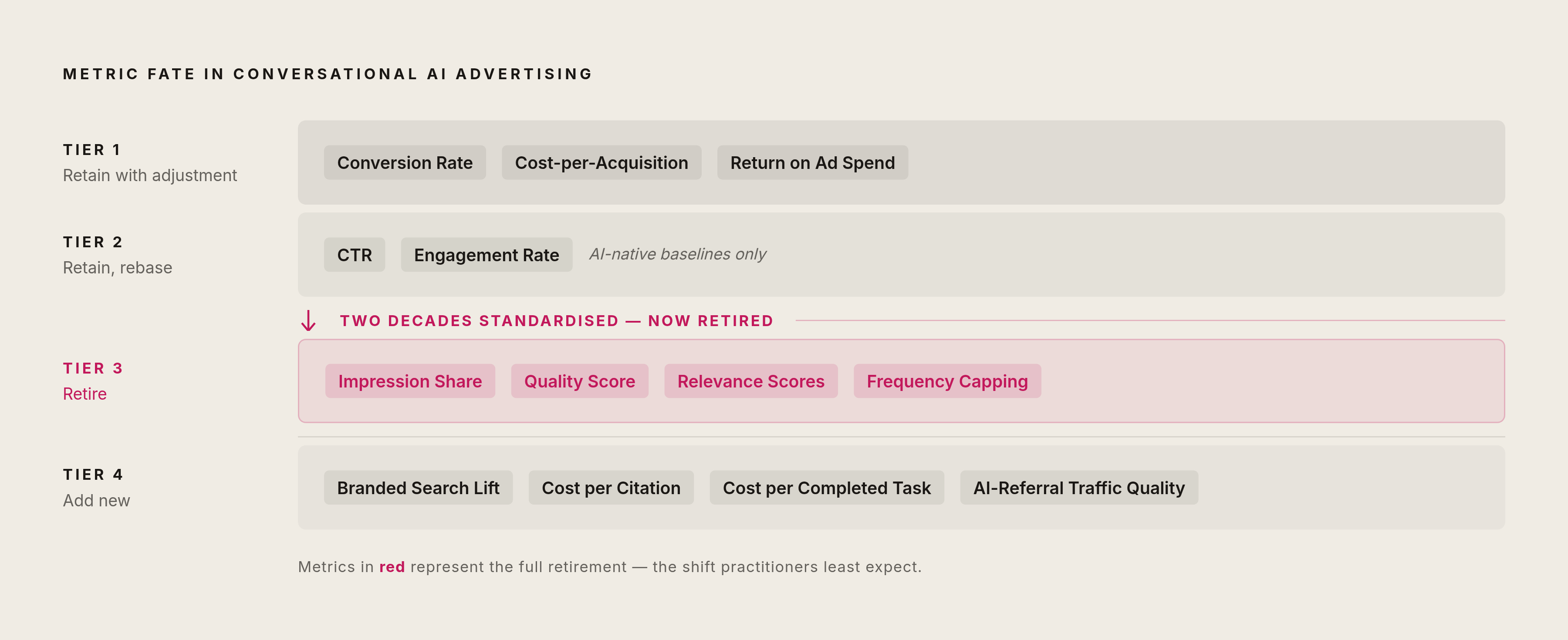
A performance marketer moving into conversational AI advertising needs a tiered reporting stack built around four distinct actions: retaining outcome metrics while adjusting their attribution windows, rebasing engagement metrics against AI-native baselines instead of legacy ones, retiring the metrics that depend on keyword or ranked-position environments, and adding conversation-level signals wherever a platform makes them available. The first tier keeps conversion rate, cost-per-acquisition, and return on ad spend, but each needs recalibration rather than a straight carryover: conversion rate should move onto server-side tracking to avoid the gaps pixel-based tracking leaves, cost-per-acquisition needs new baselines drawn from AI-channel data rather than from a search account, and return on ad spend needs an extended attribution window with a view-through component added to capture influence that doesn't resolve in a single session. The second tier holds CTR and engagement rate, both worth continuing to track but only against AI-channel benchmarks rather than search or social ones, with CTR treated as a directional signal rather than a primary measure of efficiency and engagement rate redefined operationally around follow-up actions and session depth rather than imported wholesale from its social media definition. The third tier is for retirement within this channel: impression share, Quality Score and its equivalents, relevance scores tied to keyword or feed logic, and frequency capping as a primary optimization lever all assume structural conditions, ranked auctions, keyword matching, repeated identifiable exposure, that conversational AI interfaces don't provide. The fourth tier is additive, built from signals that are newer and less standardized but increasingly available: branded search lift measured during and after exposure windows, cost per citation or cost per completed task where a platform supports that kind of measurement, and AI-referral traffic quality, tracked through session depth and the conversion rate of AI-referred visits set against other channels. Populating that fourth tier depends heavily on what a given platform is built to expose; a demand-side platform designed specifically for conversational AI advertising is positioned to surface conversation-level signals that a generalist buying platform, built for reach, simply cannot provide, which makes tier-four metrics an achievable part of a reporting stack. Not every platform currently exposes what's needed to populate that tier fully, and the measurement infrastructure for conversational AI advertising as a whole is still maturing. The framework above represents the best current approximation of a sound reporting stack for this channel, not a finished or fully solved system.