Bid Floor Mechanics in LLM Ad Exchanges
LLM ads require both monetary and relevance floors to clear, not just price.

Bid Floor Mechanics in LLM Ad Exchanges.
Why legacy floor logic doesn't fit LLM ad exchanges
Bid floors inside a large language model ad exchange work on a different logic than the floors that govern search and social, and the reason comes down to what's actually being sold. A search auction sells a position on a results page. A social auction sells an impression in a feed slot. Both are fixed containers, built ahead of time, with roughly predictable inventory shapes that a media buyer can plan against a quarter out. An LLM exchange has none of that scaffolding: no page, no feed, no keyword string to bid against, and increasingly no third-party cookie to stitch a user's history together. Almost every assumption baked into the legacy ad stack simply falls away once you take the page out of the equation.
What's left is the conversational turn itself: one exchange between a user and an assistant, generated fresh, never rendered the same way twice, and gone the moment the next message arrives. It means very little for a segment of dialogue that might be about refinancing a mortgage in one instance and about substitute ingredients for a recipe in the next.
None of this is a UX tweak layered on top of familiar exchange mechanics. It's a structural replacement, and floor-setting has to be rebuilt from first principles to fit an environment where the unit of sale changes shape every time it's created. The rest of this piece works through what that rebuild actually looks like, layer by layer, starting with the auction mechanism itself. A floor set against a slot, expressed as CPM per position, maps onto nothing stable when the "slot" is instead a live conversation segment whose value depends entirely on what the conversation is about at that moment.
The auction architecture inside an LLM exchange, from the ground up
OpenAI's ChatGPT system is the clearest reference point available, since it opened sponsored placements on February 9, 2026, and followed with self-serve buying at ads.openai.com in May of that year Every LLM Advertising Platform, Format and Cost in 2026 - AI Ad Placements. OpenAI's Help Center documentation shows how floors have to work here: the format allows one or more sponsored cards to appear beneath the assistant's answer in a single response. There's no position-based hierarchy to price against. Search has a position one and a position four, and they clear at different prices Web research brief (Claude) Web research brief (Claude) Web research brief (Claude). A conversational response doesn't have that ladder built in.
Targeting runs on intent categories and conversation states rather than keyword lists. The system is built to consider what a user is trying to accomplish, not simply which words got typed into the box. That's a meaningfully different primitive than the query-matching logic search auctions have run on for years.
The auction itself is relevance-weighted and second-price. Second-price means the winner pays just above the next-highest relevant bid. Relevance-weighted means each bid gets multiplied by a relevance score before the ranking happens, so a tightly matched ad running a lower nominal bid can beat out a generic ad running a higher one. The effective clearing price, then, is not the raw bid.
OpenAI also keeps a veto layer above the auction mechanics themselves, retaining control over which eligible ad actually gets delivered and into which conversation it lands. The publisher, in other words, doesn't just run the auction. It sits above it. What none of this explains yet is how the floor number itself gets set, or how relevance gets scored. That's the next two sections' job. As of mid-2026, access paths into the exchange include direct self-serve through ads.openai.com, a relationship via Criteo (the first named partner, connecting roughly 17,000 advertiser clients), and a relationship via StackAdapt, with each path constituting a separate commercial relationship with its own terms Every LLM Advertising Platform, Format and Cost in 2026 - AI Ad Placements.
Setting bid floors when the inventory unit is a conversational segment
Start with what a floor used to mean. In a legacy exchange, it's a minimum CPM below which no bid clears, set against a slot whose expected value is stable and known in advance. That single number did all the work.
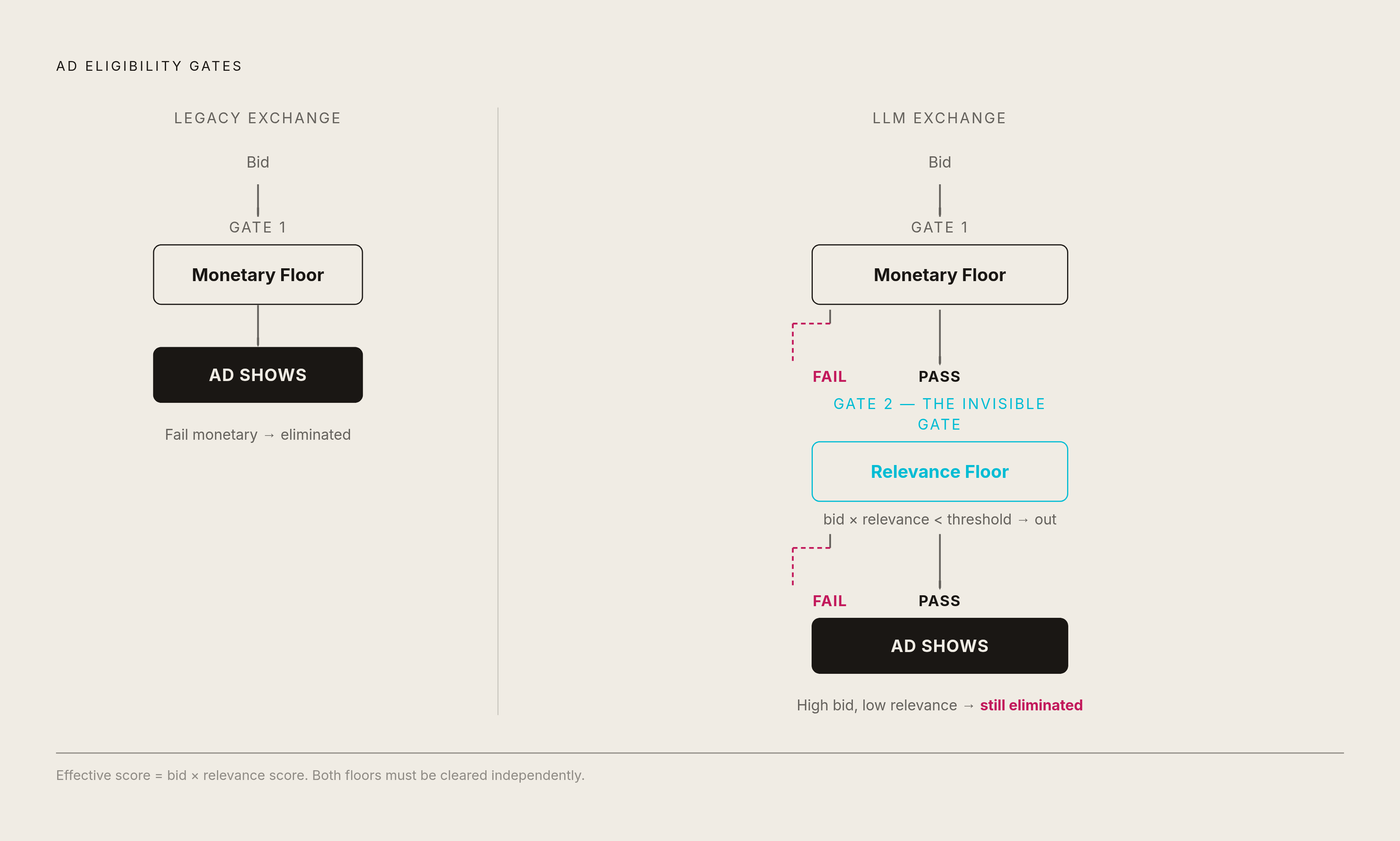
An LLM exchange needs a floor with two components that both have to be satisfied before an ad shows at all. The first is the monetary floor, the minimum bid value in CPM or CPC terms, which functions basically the way legacy floors always have. The second is new: a relevance floor, a minimum relevance score below which no ad displays no matter how high the bid goes, because showing an irrelevant ad inside a conversation degrades the very thing the publisher is selling, which is the quality of the response itself.
That relevance floor is structurally required. It's structurally required. For an LLM service to function as intended, the system has to make sure the final output, ads included, still reads as a high-quality response closely aligned with what the model would have generated on its own. Search advertising research has long framed floor prices as a filter that keeps irrelevant ads out and protects user experience. That function gets far more demanding in an LLM environment, because the ad sits inside the answer rather than next to it. A banner ad beside a search result can be ignored. A sponsored card that reads as a non sequitur inside a conversation breaks the conversation.
Several signals feed into where these floors actually get set. Topic category is one, personal finance, travel planning, software development, each carrying its own expected value. Conversation depth is another: users typically go around six prompts deep before they move off to the open internet. Early-funnel turns and late-funnel turns justify structurally different floors. User tier matters too. ChatGPT's initial ad rollout limited inventory to Free and Go tier ($8 per month) users, leaving Plus, Pro, Business, Enterprise, and Education users out of the advertising pool entirely. That's a deliberate segmentation, since premium users represent a different expected value and a different tolerance for interruption.
Because conversational context shifts turn by turn, floors can't be set once at campaign launch and left alone. Each auction and each turn need their own evaluation, which makes a static reserve price a poor fit for this kind of inventory. Every generation costs real GPU-seconds, a cost pressure that legacy exchanges never had to price around. Unlike prior software categories, where serving one more page cost close to nothing, AI apps carry a genuine variable cost per user, and that creates a structural floor of its own, one below which monetization simply doesn't cover the marginal cost of delivering the response, independent of anything happening in the auction.
The ChatGPT pricing arc from February to September 2026
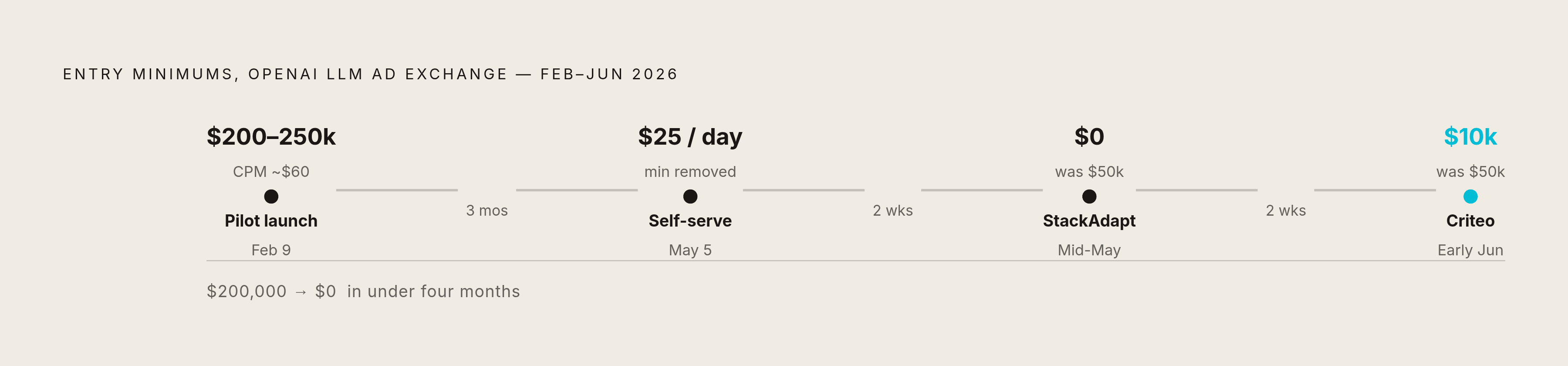
The pilot launched on February 9, 2026, at a floor of roughly $60 CPM, a number that reflected both genuine supply scarcity and real uncertainty about what conversational inventory was actually worth Every LLM Advertising Platform, Format and Cost in 2026 - AI Ad Placements. Within about ten weeks, that CPM had fallen substantially from its opening level, which is what a new exchange discovering its real clearing price in real time looks like.
The pricing model itself shifted too. On May 5, 2026, OpenAI launched its self-serve Ads Manager and introduced CPC bidding alongside the existing CPM option, moving away from a pure impression floor toward one tied to action, pricing conversational intent more directly rather than just exposure.
Minimum spend requirements tell a parallel story, and arguably a more dramatic one. That threshold didn't survive the year. OpenAI removed the platform-level minimum spend for US businesses on May 5, 2026, letting self-serve campaigns start at $25 a day Web research brief (Claude). StackAdapt dropped its own $50,000 pilot minimum all the way to zero in mid-May, opening the door to roughly its full roster of 1,000 advertisers Web research brief (Claude). Criteo followed in early June, cutting its minimum from $50,000 to $10,000 and pairing the cut with incentives around product-feed integration Web research brief (Claude) Salesforce State of Marketing Every LLM Advertising Platform, Format and Cost in 2026 - AI Ad Placements.
Compressing a $200,000-plus entry commitment down to a zero-dollar minimum in under four months isn't generosity Web research brief (Claude) Web research brief (Claude) Web research brief (Claude). It reads as a land grab, an effort to lock in advertiser relationships and feed integrations before the platform matures to a point where it can afford to disintermediate the very partners who helped seed its early inventory Web research brief (Claude) Web research brief (Claude) Web research brief (Claude). The pattern it leaves behind is instructive for anyone standing up a floor on a new LLM exchange: open conservatively, price high enough to protect response quality and filter out advertisers who aren't serious, then recalibrate downward once relevance scoring is mature enough that real clearing prices become observable. CPC, in this light, looks like the more durable floor unit long-term. Pricing per click rather than per impression aligns the floor with the transactional intent that actually makes conversational inventory valuable in the first place, rather than with mere exposure. Pilot entry required a commitment of $200,000–$250,000 in February, with this spend floor functioning as a quality filter at a time when the inventory was invitation-only Web research brief (Claude) Web research brief (Claude) Web research brief (Claude). OpenAI reported a $1B annualized revenue run rate reached in under 200 days, and self-serve access had expanded to Europe, India, the Middle East, and North Africa Web research brief (Claude) Every LLM Advertising Platform, Format and Cost in 2026 - AI Ad Placements.
Relevance scoring as the invisible second floor
A standard second-price auction gives a bidder one lever: know the floor, bid above it, and the auction clears. A relevance-weighted LLM auction removes that certainty entirely. A bidder who doesn't understand how the relevance scorer works can't actually know their effective floor, because a bid that's nominally above the stated minimum can still fail to clear if the relevance component drags the product down too far.
Several things feed that score. Topic category match is one: advertisers pick broad categories and subtopics, and a project management tool targeting "team collaboration" and "remote work productivity" is going to score higher in a conversation about distributed teams than a generic SaaS ad ever could. Creative fit matters just as much. The ad unit has to read as a genuinely useful continuation of whatever the assistant just said, not an interruption bolted onto it, and creative built specifically for that context will consistently outscore a generic banner repurposed for the format.
Advertisers, notably, don't get to see the raw signal that drives any of this. OpenAI won't hand over access to individual user conversations or personal data; what advertisers receive is aggregated performance data, total impressions and clicks, nothing more granular. OpenAI's updated privacy policy does let advertisers send purchase and conversion data back into the system, and OpenAI may in turn share limited user data with marketing partners for third-party targeting purposes, but the placement decision itself stays entirely on OpenAI's side of the wall Every LLM Advertising Platform, Format and Cost in 2026 - AI Ad Placements. Advertisers control budget, bid, pacing, and creative. They do not control, or even fully observe, where the ad actually lands.
That opacity has a direct operational consequence: winning in an LLM exchange requires optimizing creative relevance as aggressively as bid price, since the floor is partly in the copy. Google researchers have floated something called the Token Auction model as one vision of where this could head, a paradigm where advertisers bid not for a slot but to shape the actual words the model generates, submitting something like a brand-voice language model alongside a bid. Nothing like that is running today, but it's a useful marker of the direction relevance-as-floor logic is heading. For now, the practical lesson holds regardless: winning inventory in an LLM exchange means treating creative relevance with the same seriousness as bid price, because a meaningful part of the floor lives in the copy itself, not just the number attached to it.
Prompt-level intent signals and floor valuation across the funnel
A search query tells an advertiser what someone typed. A conversational prompt tells an advertiser what someone actually wants, along with their constraints, their preferences, and roughly where they sit in the decision process, all inside a single turn. That's a categorically richer signal, and it's the reason floor valuation in this channel needs to track intent stage, not just topic.
This shift is large in scale. Analysis of more than a billion daily signals from Verve found that the pre-purchase digital journey now starts with AI chat for over a fifth of users, with categories like travel skewing even more heavily toward AI as the entry point. Inside a single conversation, the funnel narrows fast: initial prompts tend to be unbranded, exploring a category broadly, but the consideration set tightens with each subsequent turn. In the auto category specifically, a user who starts in chat often ends up choosing between only about two brands by the time the conversation concludes. Conversion timing varies by category too. Flights and electronics tend to convert within 48 hours, while other categories stretch out to two weeks, so a late-funnel transactional turn and an early informational one simply cannot be priced the same way. OpenAI's own figures put roughly a fifth of all ChatGPT conversations as carrying some form of shopping intent, spanning retail, home, beauty, travel, cooking, auto, electronics, and fitness, and those are precisely the conversations where a floor premium is earned rather than arbitrary.
The floor logic that follows is fairly intuitive once the intent layer is made explicit. Informational intent, someone still researching, should carry a lower floor reflecting lower conversion odds. Comparative intent, someone weighing named options, justifies a higher one. The underlying claim being made here is bigger than pricing mechanics: the monetizable unit is shifting away from pages and impressions and toward intents, tasks, and decision moments that live inside conversations, and that shift is the actual theoretical foundation for building floors that vary by intent rather than by placement.
One complication cuts against clean measurement here. Bidders leaning on last-touch ROAS will systematically underbid relative to the channel's true value, and that gap creates inefficiency on both sides of the floor, since publishers underprice inventory that's actually working, and advertisers underpay for the intent they're actually capturing. Transactional intent marks a user ready to act, carrying the highest conversion probability, and the floor should reflect direct-response value, potentially commanding a meaningful premium over an equivalent CPM in search or social.
How LLM-based auto-bidding systems interact with exchange floors
Auto-bidding's core purpose hasn't changed from the pre-LLM era: adjust bidding parameters dynamically across a campaign's delivery window to maximize conversions while staying inside advertiser-set constraints like target cost-per-action, a framing laid out in the SAGE paper from Cai et al., built on research out of Taobao, Tmall, and the University of Electronic Science and Technology of China. What's new is the reasoning layer LLM-based systems add on top of that goal. These systems use text information directly and take advantage of long-context reasoning to model what an advertiser is actually trying to achieve, which lets bids respond to conversational signals in real time rather than relying purely on historical auction data.
A few research directions stand out here. Planning-based generative bidding builds in a mechanism for anticipating how a conversation will unfold, so the current bid reflects not just the present turn but where the exchange is likely headed next. The SAGE framework itself uses temporal-semantic positional embeddings to capture the underlying dynamics and structure of a bidding trajectory over time, paired with something called constraint-gated LoRA, a method for adapting a frozen LLM backbone efficiently without retraining the whole model. That combination points to parameter-efficient adaptation of large models for bidding as a genuinely active research frontier right now.
None of this erases the basic gravitational pull that floors exert on bidding behavior. When an auto-bidding system optimizes against a floor, it tends to cluster bids just above the minimum, a pattern familiar from years of search exchange dynamics. The complication in an LLM exchange is that the floor being cleared is a dynamic threshold shaped by relevance scoring, not a fixed reserve number at all. It's bid multiplied by relevance, so an auto-bidder clustering just above what looks like the stated floor can still lose the auction if the relevance term comes in low. Floors here can't be treated as static targets to inch past.
Sources
- What Is LLM Ad Infrastructure? 4 Layers Explained (2026) | Lapis
- The ChatGPT-Ads Land Grab: Ad Networks Cut Minimums
- Strategy-Aware Parameter-Efficient Adaptation for LLM-based Auto-Bidding
- How to Build an LLM Advertising Stack: Tools, Workflow, and Budget (2026) | Lapis
- Every LLM Advertising Platform, Format and Cost in 2026 - AI Ad Placements
- sigecom.org
- searchengineland.com
- press.verve.com