Statistical Significance Thresholds for Low-Volume AI Ad Tests
AI ad tests need higher statistical bars than legacy platforms due to low impression volume.
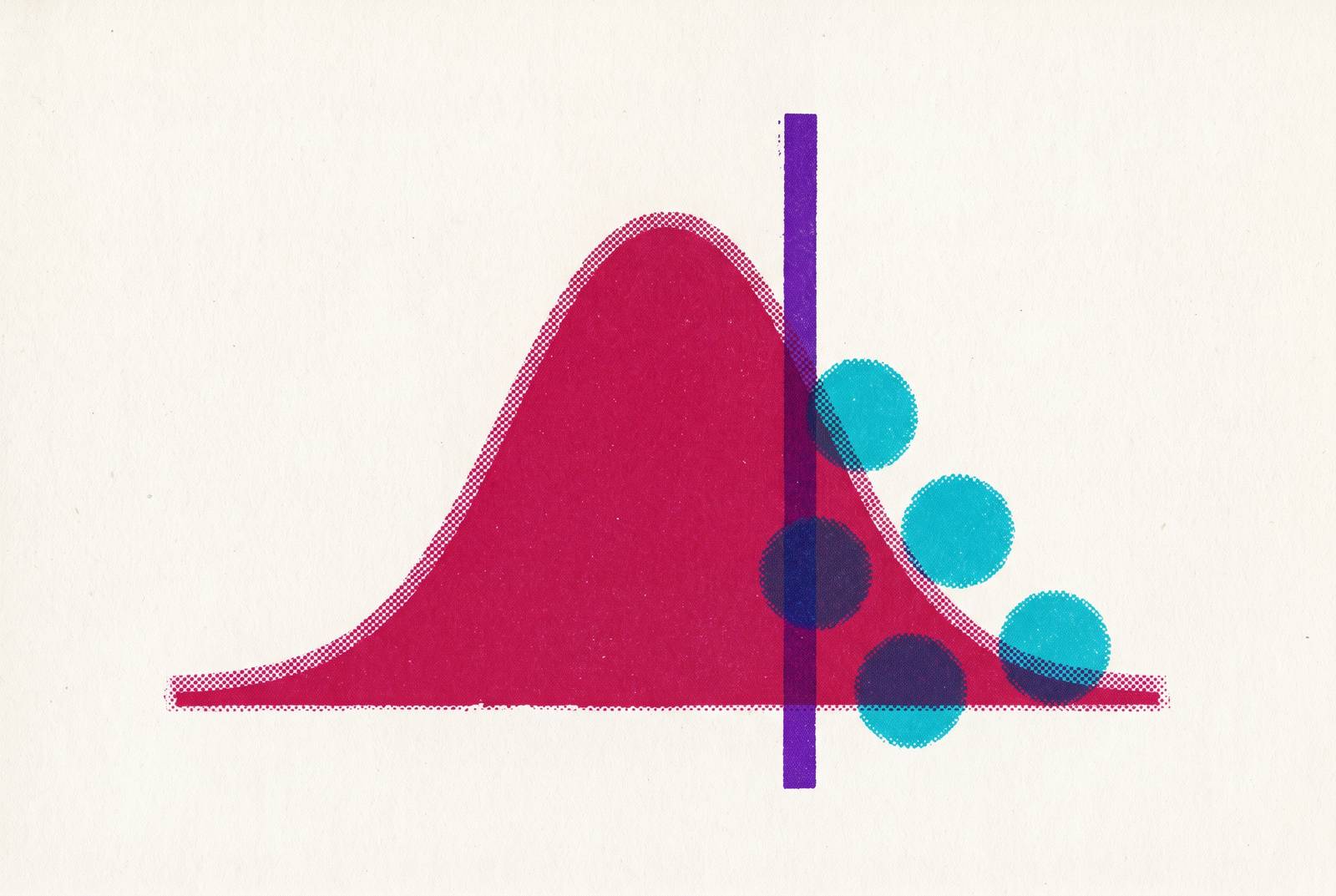
Statistical significance thresholds from search or social need to change for low-volume AI ad tests. With less inventory, more variants and little reporting on context, false winners are harder to avoid and spot. Sound testing starts with the smallest lift worth acting on, then needs enough power, comparison-adjusted significance, a novelty hold and replication before scaling.
Why AI ad surfaces produce structurally fewer impressions than legacy channels
Conversational interfaces create fewer opportunities to serve ads than search or social, so their impression constraint is structural. Targeting operates on a natural-language context hint resolved at auction time, rather than on keywords or third-party audience segments. First-party custom audiences and personalization signals from past chat history are also available, but eligibility still depends on conversational relevance. That narrows the inventory available to a test by design.
Unit cost compounds this supply constraint. ChatGPT's CPM launched at roughly three times what Meta charges, although current rates have narrowed that gap significantly. A fixed budget therefore faced an impression deficit from both the frequency of eligible placements and their price. The testing consequence is a smaller denominator over which to distinguish creative performance from ordinary variation. More budget may address part of that constraint, but it does not change how the interface creates ad opportunities.
How the confidence thresholds inherited from legacy platforms were calibrated for high-volume environments
Legacy platforms established their testing defaults in environments where a campaign can accumulate hundreds of thousands of impressions in days. At that scale, growing samples shrink variance and make it practical to reach a confidence threshold within a campaign's working life. Practitioners importing those defaults into conversational inventory inherit the decision bar without necessarily inheriting the traffic that supports it. Even a stricter threshold is not a substitute for sufficient data.
Meta declares A/B test winners at a much lower confidence threshold than Google Ads experiments, which use two-tailed significance by default. Most practitioners still see Google's stricter default as too low, and neither default on its own accounts for multiple variants or the winner's curse. The inherited standard therefore depends on which platform a practitioner uses, rather than on a deliberate choice about acceptable error. A loose confidence bar permits a substantial nominal false-positive risk, but that risk is not itself the share of declared winners that are false.
Google Ads A/B testing guidance recommends high confidence, several weeks of run time and an even budget or traffic split, depending on campaign type. Low-volume AI inventory may not yield enough observations in that time.
What false discovery rates look like at realistic AI ad test volumes
When a fixed impression budget is split across many variants, each comparison has less data to draw on. On a low-volume surface, that leaves tests less able to distinguish a real lift from noise. Underpowered tests do not merely miss useful improvements. Among results that clear the significance bar, unusually favorable fluctuations can inflate the apparent effect, producing the winner's curse.
With low volume, a declared winner is more likely to be a false discovery, especially when teams also use a loose threshold. No specific false discovery rate can be assigned to AI ad surfaces from the evidence here. The important distinction is between the nominal error rate attached to a testing rule and the reliability of the winners a workflow produces.
AI generation widens the variant matrix through more hooks, CTAs, lengths and tones without widening the impression pool. The resulting workflow can produce more false winners while making those winners look stronger than they are, setting up disappointment when spend scales.
Why the reporting gap inside conversational AI platforms makes the problem harder to catch
Statistical discipline also depends on understanding the conditions under which observations were collected. Performance media buyers have reported that conversational AI ad reporting does not show exactly what users asked when ads were served. Without a search- or prompt-level equivalent, they cannot fully check whether competing variants ran in similar conversational contexts. This is a structural limit on interpretation.
The distinction matters because targeting uses a natural-language context hint at the ad-group level. An even audience split does not, by itself, establish that the context mix remained comparable throughout the test. Buyers have also requested negative targeting and prompt-matching visibility, which would help them understand and exclude confounding contexts. Their absence leaves part of the experimental setting opaque.
On October 5, 2026, Integral Ad Science announced brand safety and suitability measurement inside ChatGPT Ads. That signals the arrival of independent verification infrastructure, but its scope is different. Measuring what an ad ran next to does not establish which prompt triggered it.
How to set a minimum detectable effect before launching a test on low-volume inventory
The first corrective action is to specify the minimum detectable effect before launch. MDE is the smallest lift worth acting on commercially. It turns a general wish for confidence into a sample-size requirement that can be compared with available inventory. Detecting a smaller lift reliably requires disproportionately more traffic, so an ambitious sensitivity target can make a test impractical before it begins.
The practical sequence is to define that lift, calculate the required sample size and compare it with the surface's estimated impression delivery rate. If the inventory cannot support the design, the available adjustments are to raise MDE, extend the window or consolidate variants. Raising MDE means accepting that the test will not reliably resolve smaller improvements. It does not make those improvements commercially irrelevant.
That decision must precede the results. Choosing MDE after seeing the observed lift makes the justification circular, while peeking before the pre-set sample size is reached inflates false-positive risk. A modest CTR improvement may matter to the business yet remain beyond what the available inventory can reliably detect.
Adjusting power requirements and test duration when impressions accumulate slowly
Once MDE is fixed, statistical power determines how likely the test is to detect an effect of that size when it exists. Meta recommends calculating power before the test, with a target of an estimated 80% or higher. That estimate leaves open the possibility that a particular test will miss a real improvement. Missing a useful winner also becomes more costly when another test cycle requires weeks to accumulate impressions.
Slow delivery changes the time needed to reach the required sample while preserving the evidentiary value of each impression. The response is therefore to reduce the variant count, raise MDE or extend the test window while maintaining the confidence threshold. Each choice gives something up, namely breadth of comparison, sensitivity to smaller lifts or speed. Teams that accept more uncertainty must say so, even if they keep testing the same way.
Extending the window also has a cost beyond delay. Seasonal query patterns, news events and product announcements can change the mix of conversational contexts while the test runs. More elapsed time can supply observations while making the underlying conditions less stable, so duration cannot be treated as an unlimited remedy.
Correcting for multiple comparisons when AI tools generate many variants at once
Adequate power for an individual comparison does not control error across an entire set of comparisons. Each comparison has some false-positive risk, so running more of them creates more chances for at least one false winner. The family-wise false-positive rate can then be higher than the rate for any one comparison. A strict bar applied repeatedly is not the same as a strict bar for the whole experiment.
The correction is to account for how many comparisons the decision includes. Keeping the same family-wise error rate across more comparisons takes a stricter confidence bar for each comparison. A two-variant test and a ten-variant test need to be judged with their different chances of selecting noise in mind. This matters especially when the same limited inventory must also support every additional arm.
The practical alternative to testing all combinations at once is to test variable classes sequentially. Hooks can come first, followed by CTAs and then length, keeping each experiment to a clean two- or three-cell comparison. Generation makes variants cheap to create, but evidence that can be trusted is still hard to come by.
Holding results against the novelty effect before declaring a winner
A comparison-adjusted significant result can still reflect a temporary response to an unfamiliar format. Conversational AI ads are new enough that users may click because the placement is novel, leaving uncertain whether one message is durably effective. That response can decay as users become familiar with the surface. An early lift may consequently flatten or reverse when the same users encounter ads over subsequent weeks.
A novelty hold addresses this separate threat to validity. Before scaling, require performance to move in the same direction across at least two non-overlapping time windows. An apparent winner that fades or reverses in the second window has not demonstrated the stability needed for that decision. Statistical significance in the first window does not waive the hold.
This gate is particularly relevant to ChatGPT Ads because its move from limited pilot to self-serve availability changes both the user population and its familiarity with advertising. Those changes can make it hard to tell novelty decay apart from broader platform effects. The hold is therefore a practical filter for a known failure mode.
A five-gate decision ladder for declaring results on low-volume AI ad tests
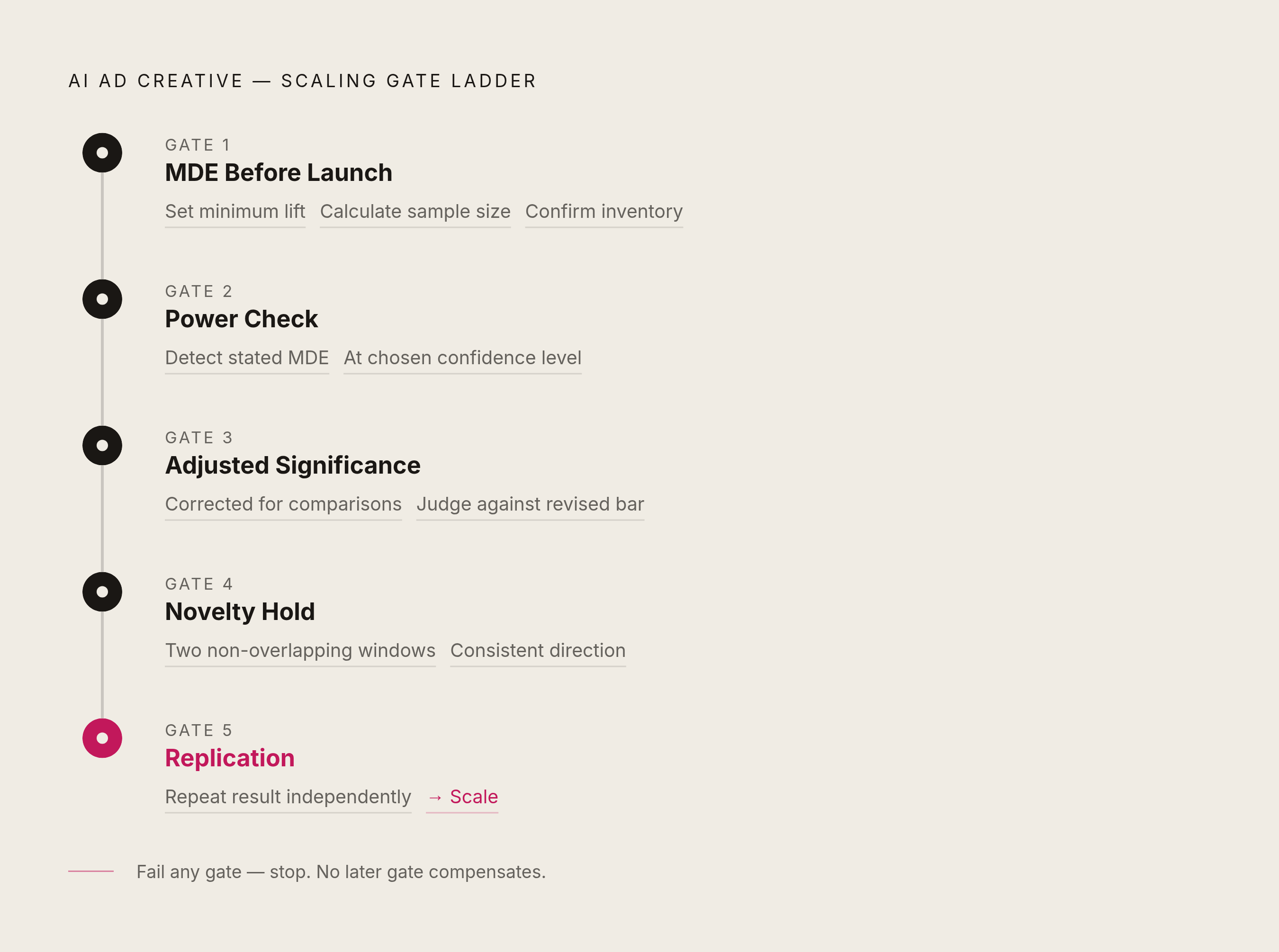
Each gate checks a different reason an apparent winner may fail, and passing a later check cannot make up for failing an earlier one. The sequence begins before launch and ends before scaling. Its purpose is to make the next decision depend on evidence already established.
Gate 1 is MDE before launch. Set the minimum lift worth acting on, calculate the required sample size and check that the expected inventory can supply it in the planned window. If it cannot, revise the design before proceeding. Gate 2 is the power check, which establishes whether that design can detect the stated MDE at the chosen confidence level. A test that cannot reach adequate power should not launch in the hope that waiting will resolve the shortfall.
Gate 3 is significance adjusted for the number of comparisons. A candidate should be judged against that bar only after the test has met the evidence requirements set in its plan. Gate 4 is the novelty hold, which requires consistent direction across at least two non-overlapping time windows. A result that reverses cannot advance simply because its earlier significance looked persuasive.
Gate 5 is replication, which requires the candidate to repeat its result. A creative that fails any gate is not ready to scale, regardless of how convincingly it cleared the others.
What responsible result declaration looks like in practice on today's AI ad inventory
Responsible declaration states what the test could detect before stating what it found. An adequately powered test may find no lift at or above its MDE, which is a useful negative result that leaves smaller effects unresolved. An inconclusive test is different because it has not resolved the decision at the planned sensitivity. Preserving that distinction is more valuable than turning uncertainty into a winner.
Incrementality testing provides a more robust frame when variant-level significance is difficult to achieve. It asks whether an AI-ad-exposed group converted at a higher rate than a holdout. That addresses whether spend brings new customers or cannibalizes other channels. Any declared creative winner should also note that conversational context conditions could not be fully verified and should remain directional while that reporting gap persists.
ChatGPT Ads moved to self-serve in 63 countries by late September 2026 with no minimum spend. As access grows, sound measurement becomes more urgent because old habits can spread into the channel faster than testing practices that fit it. The standard is not a steady supply of winners, but decisions whose stated certainty matches the evidence available.